
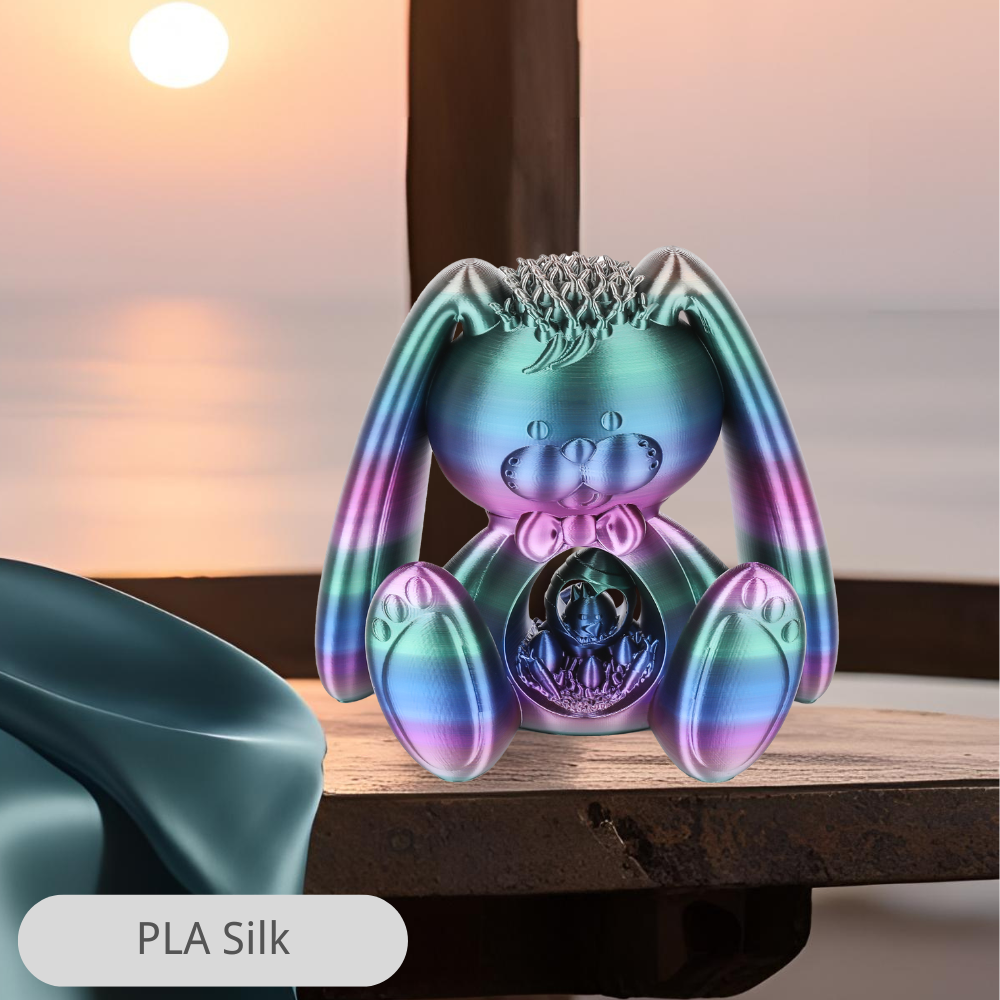
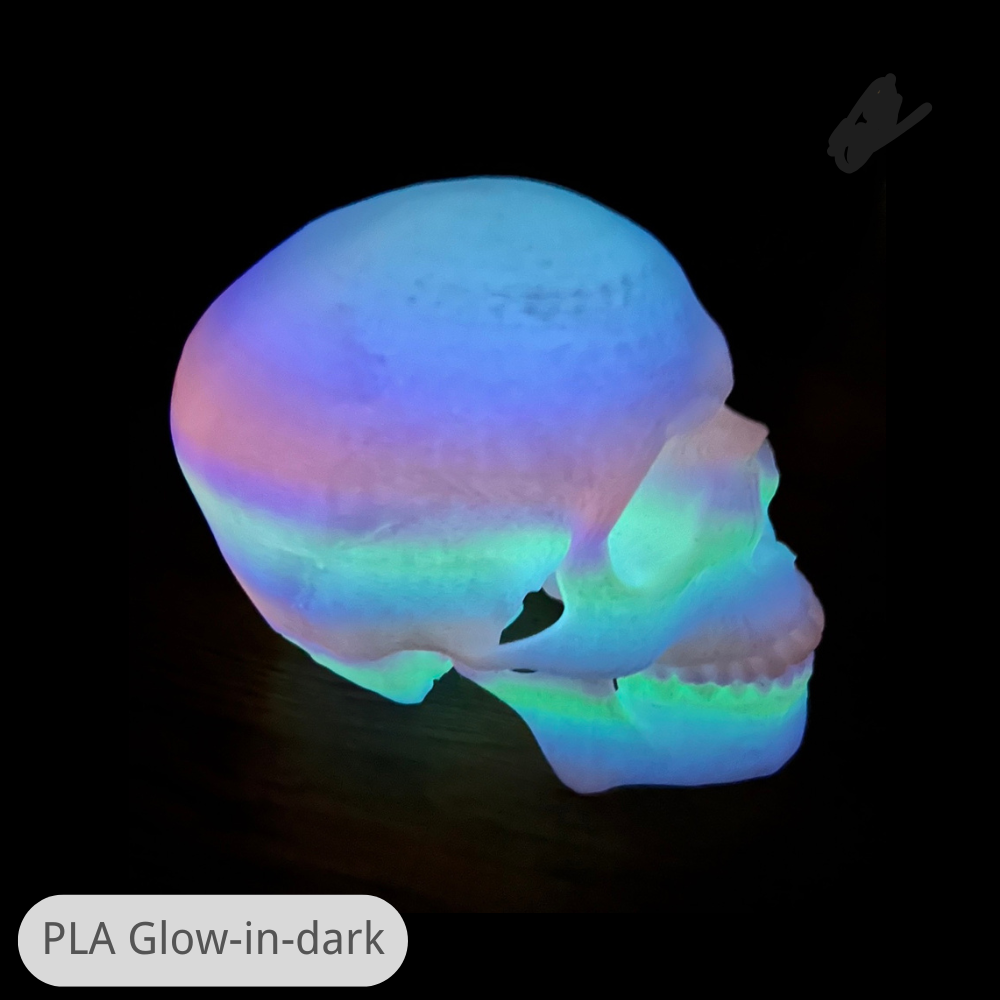
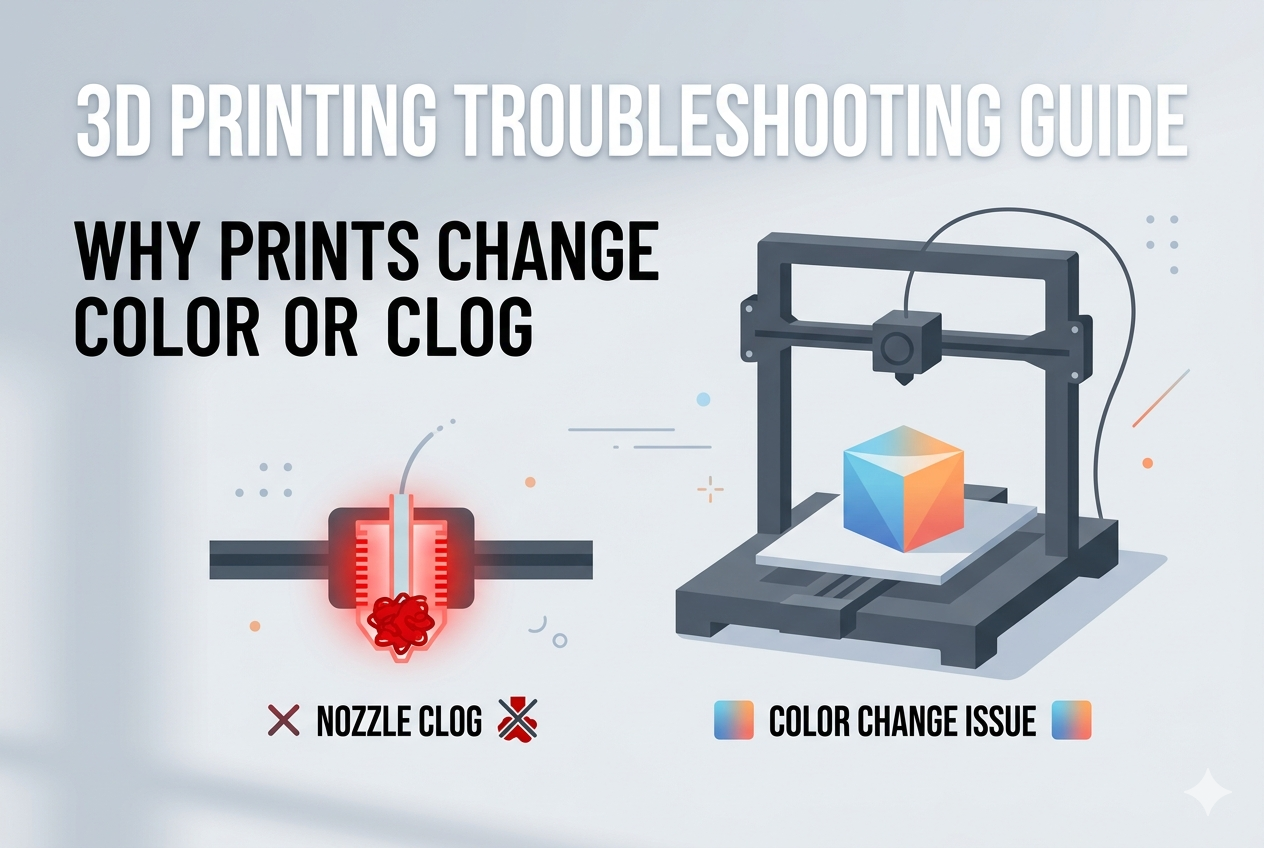
You’re not imagining it: a print can look like it “changed color” halfway up even when you didn’t swap filament. And clogs often show up right when you think you’ve finally dialed in the profile.
The annoying part is that these two problems overlap. A real color issue (batch variance, pigment behavior) can happen — but a lot of “color shifts” are actually finish shifts: one section is glossier, another is more matte, and your eyes read that as a different shade. Those finish shifts are usually caused by the same things that lead to under-extrusion and clogs: unstable melt, unstable flow, or unstable cooling.
This is a 3D printing troubleshooting guide for the consideration stage: not a list of 30 random causes, but a workflow that helps you isolate the root cause quickly, compare fixes, and stop making things worse.
Start here: a two-minute 3D printing troubleshooting guide triage
Before you change settings, answer three questions. They’ll tell you which branch to follow.
Is the “color shift” actually a texture/shine shift?
- Same spool, same model.
- The “different color” bands look like matte vs glossy.
- The shift lines up with geometry changes (a logo starts, infill gets heavier, the model narrows/widens).
- If yes, jump to “Finish shift: why matte/gloss bands happen.”
Is extrusion also inconsistent? Look for any of these on the same print:
- thin walls, gaps, or missing lines
- clicking from the extruder
- a rough, pitted surface
- random weak layers you can snap by hand
If yes, jump to “Clogs and under-extrusion: diagnose by symptom pattern.”
Does it happen with more than one filament spool? If it only happens with one specific color/spool, suspect filament (moisture, diameter variation, pigment behavior). If it happens across spools, suspect machine/settings.
Pro tip: Don’t change two things at once. If you adjust temperature and retraction and flow, you’ll “fix” it without knowing what actually mattered — and the next spool will break your profile again.
The fast map: symptoms, fastest tests, likely causes
Use this table to avoid the classic time sink (chasing the wrong problem).
|
What you see |
Fastest test |
Most likely cause |
First fix to try |
|---|---|---|---|
|
Distinct bands that look like a shade change, but feel smoother/rougher |
Check if the band aligns with a speed or geometry change in preview |
Finish shift (speed/layer time/cooling) |
Lock down speed + minimum layer time; smooth fan behavior |
|
Surface looks “foamy,” pitted, or you hear popping/hissing |
Extrude 50–100 mm in mid-air and listen |
Wet filament |
Dry the spool and store sealed |
|
Print starts fine, then under-extrudes 20–60 minutes in |
Check hotend heatsink fan + airflow |
Heat creep |
Fix cooling/airflow; reduce retraction; lower chamber heat |
|
Random gaps/thin walls without a full jam |
Raise nozzle temp by 5–10°C for a test |
Partial clog or too-cold printing |
Cold pull; then tune temp/speed |
|
Extruder clicks or grinds filament |
Inspect drive gear dust + idler tension |
Slipping/poor grip or high back-pressure |
Clean gear, adjust tension, reduce flow demand |
|
New nozzle/hotend work preceded the issue |
Inspect for leaks / burnt residue near heater block |
Assembly gap or leak causing debris |
Re-seat nozzle/heatbreak correctly; clean residue |
Finish shift: why matte/gloss bands happen (and how to stop them)
If you’re printing from a single spool and the “color change” looks more like gloss vs matte, you’re usually seeing a surface physics problem, not a pigment problem.
One useful hint comes from a Bambu Lab community discussion where users traced layer-by-layer texture changes to speed changes affecting how long filament is heated (more heating and flow tends to look smoother/glossier; less heating can look rougher/more matte): a Bambu Lab community thread on layer-to-layer texture shifts.
The four drivers of matte vs glossy layers
- Speed changes
- If your slicer slows down for small perimeters, overhangs, or high detail, you can get alternating “shiny” and “dull” zones.
- Adaptive speed features are great — until they create visible banding.
- Layer time changes (small layers vs big layers)
- On tall prints, the time per layer changes as the cross-section changes.
- That changes cooling and how the plastic crystallizes/sets.
- Cooling changes
- Fan ramps (especially when bridges start) can flip the surface finish in one layer.
- Temperature stability
- A hotend that overshoots/undershoots can change how “wet” the extrusion looks on the surface.
Fixes that actually work (in order)
Fix 1: Make speed more uniform where the shift happens
If the band aligns with a feature (logo, text, infill change), try:
- narrowing the gap between “inner wall” and “outer wall” speeds
- reducing acceleration/jerk so the printer doesn’t swing between fast and slow
- disabling aggressive adaptive speed features for that model
Done when: the finish becomes consistent across a test print that previously showed the band.
Fix 2: Stabilize minimum layer time and cooling behavior
- Many slicers can enforce a minimum layer time by slowing down small layers.
- That helps cooling — but it can also create exactly the finish shift you’re trying to avoid.
Instead of “slow down a lot,” aim for:
- moderate minimum layer time
- consistent fan behavior (avoid sudden jumps)
Done when: the “ring” doesn’t appear at the same Z-height across multiple prints.
Fix 3: Use temperature only after speed/cooling are sane
- If you’re on the edge of the melt range, tiny speed changes can look like color changes.
- Print a small “finish test” at two temps (e.g., +5°C, +10°C) rather than changing everything.
Done when: you can predictably choose “more matte” vs “more glossy” based on temperature.
True color inconsistency: when it’s actually the filament
Sometimes it is the filament. Here are the cases where blaming the spool is fair.
1) Batch-to-batch pigment behavior
Pigments and additives aren’t just “color.” They can change how a plastic flows and cools, which affects appearance and printing window. If one color needs 10°C hotter than another, that’s normal.
Fast test: Print the same small part with:
- the problematic colored spool
- a “natural” (unpigmented) or a different brand spool
If the problem vanishes with natural filament under the same conditions, you’ve isolated a pigment/additive variable.
2) Filament diameter variation
If filament diameter varies more than it should, flow varies — and surface finish varies too.
Fast test: Measure diameter in 10 spots over 1–2 meters and average it. If it swings a lot, you’ll see inconsistent extrusion.
3) Wet filament masquerading as a color problem
Wet filament can cause bubbles and roughness that reads like a shade change.
An overview of how moisture turns into steam in the nozzle describes the classic symptoms (popping/hissing, bubbles, rough surfaces, inconsistent flow): an overview of how filament moisture turns into steam in the nozzle.
If you need a practical temperature/time starting point by material, Sovol has a straightforward reference (we’ll come back to it in the prevention section): Sovol’s filament drying temperatures guide.
Clogs and under-extrusion: diagnose by symptom pattern
A 3D printer nozzle clog is rarely random. The timing and the sound usually tell you what’s happening.
Symptom pattern 1: “It prints fine… then dies 20–60 minutes in”
This is the classic heat-management failure mode (often called heat creep).
What’s happening: filament softens too high up, swells, and increases friction. The extruder starts clicking or chewing the filament.
Fastest checks
- Is the hotend heatsink fan actually spinning at full speed the entire print?
- Are the heatsink fins packed with dust?
- Are you printing PLA inside a warm enclosure?
First fixes
- Clean the heatsink and confirm the fan runs continuously.
- Vent the enclosure for PLA.
- Reduce retraction distance and frequency.
Done when: you can run a 60–90 minute print without the extrusion getting progressively worse.
Symptom pattern 2: “Thin walls, gaps, but it never fully jams”
This is usually partial clog or too much flow demand (printing too cold/fast for the nozzle size).
Fastest checks
- Raise nozzle temperature by 5–10°C for a test.
- Reduce volumetric flow (slow down, lower line width, lower layer height).
First fixes
- Do a cold pull (see next section).
- Then tune temperature and speed so you’re not riding the edge.
Done when: a single-wall test print produces a consistent line with no “starved” sections.
Symptom pattern 3: “Clicking + ground filament dust around the drive gear”
This might still be a clog — but it can also be simple feeding failure.
Fastest checks
- Open the extruder and check the drive gear teeth for packed filament dust.
- Check idler tension: too loose slips, too tight grinds.
Sovol’s inconsistent extrusion checklist includes the practical causes (moisture, nozzle buildup, tension, speed, and calibration): Sovol’s inconsistent extrusion checklist.
Done when: the extruder can push filament smoothly at printing temperature without audible clicking.
Cold pull: the safest way to clear a partial clog
If you suspect a partial clog, a cold pull is usually the first “real” maintenance step that doesn’t require disassembling your hotend.
All3DP’s overview explains when a cold pull makes sense and what you should look for on the pulled filament: All3DP’s cold pull guide.
Cold pull quick checklist
- Heat to normal printing temperature.
- Extrude a little to ensure the melt zone is full.
- Cool to the material’s pull temperature (firm, not rubbery).
- Pull straight out and inspect the filament tip.
What you want to see: the nozzle opening shape replicated cleanly in the pulled filament, with any dark specks or debris embedded.
Done when: you can extrude 50–100 mm in air with a smooth, consistent strand.
⚠️ Warning: If you’re repeatedly cold-pulling and it always comes out dirty, you’re treating a symptom. Look for the root cause: dust, abrasive fill, leaks, or heat creep.
Calibrate extrusion the boring way (it’s worth it)
If your printer is mechanically sound and your filament is dry, persistent “color shift” and “random clogging” often trace back to extrusion that isn’t actually consistent.
Step 1: Calibrate extruder steps (E-steps) / rotation distance
You’re setting the hardware baseline: when the printer commands 100 mm, it should feed 100 mm.
- For a clear walkthrough, use: a step-by-step E-steps calibration guide.
- If you’re on Klipper, Ellis’ approach and terminology are the cleanest: Ellis’ Print Tuning Guide on extruder calibration.
Done when: repeated tests are within a millimeter or two, without the extruder slipping.
Step 2: Calibrate flow / extrusion multiplier per spool
Even after E-steps are correct, different spools can need slightly different flow.
- If your walls are too thin, your print can look “washed out” or rough.
- If your walls are too thick, you get extra shine, blobs, and sometimes back-pressure that contributes to clogs.
Done when: wall thickness matches your intended line width and top surfaces look even.
Retraction and back-pressure: the settings that create clogs
Retraction is useful. Over-retraction is a quiet clog factory.
If you see a “mushroomed” filament tip when unloading, or clogs happen after lots of travel moves:
- reduce retraction distance
- reduce retraction speed if it’s chewing the filament
- avoid retracting on tiny moves
Done when: you can print a retraction-heavy model without a mid-print jam.
Prevention: keep the system clean, dry, and predictable
This is the part most people skip — then they wonder why the same profile fails a month later.
Keep filament dry and dust-free
Moisture is obvious. Dust is sneakier.
- Storage habits that actually help: Sovol’s tips for keeping filament dry and dust-free.
If your filament snaps easily or prints suddenly get rough, Sovol’s overview of brittleness causes is also a useful sanity check: Sovol’s list of common beginner mistakes.
Build a tiny maintenance routine
- Wipe filament before it enters the extruder (a simple foam “wiper” works).
- Check that your hotend heatsink fan runs freely.
- Do a cold pull after a problematic spool or after abrasive filaments.
Next steps
If you want a single place to go deeper on clog patterns and prevention, start with: Sovol’s guide to why nozzles keep clogging.
And if wet filament is even a possibility, keep this reference handy: Sovol’s filament drying temperatures guide (linked earlier in the article).
FAQ
Why does my print look like it changed color at the same height every time?
If the “color change” repeats at the same Z-height, it’s often tied to a geometry change that triggers different speed, layer time, or cooling. That creates a matte/gloss shift that reads as a different shade.
Can one spool print both glossy and matte?
Yes. Surface finish is strongly affected by how the filament is melted and cooled. Changes in speed, fan behavior, and layer time can flip the texture.
Why do clogs happen more with PLA in an enclosure?
PLA softens at relatively low temperatures. In a warm chamber, the hotend’s “cold side” can get too warm, increasing friction and encouraging heat creep.
Is wet filament always obvious?
Not always. Severe cases pop and hiss. Mild cases can show up as rough surfaces, occasional under-extrusion, and inconsistent finish before you hear the classic sounds.
When should I just replace the nozzle?
If you’ve confirmed the filament is dry, cold pulls keep coming out dirty, and you’ve ruled out leaks/heat creep, a fresh nozzle is often the fastest reset. It’s also the right move if the nozzle is worn (especially after abrasive filaments).
