
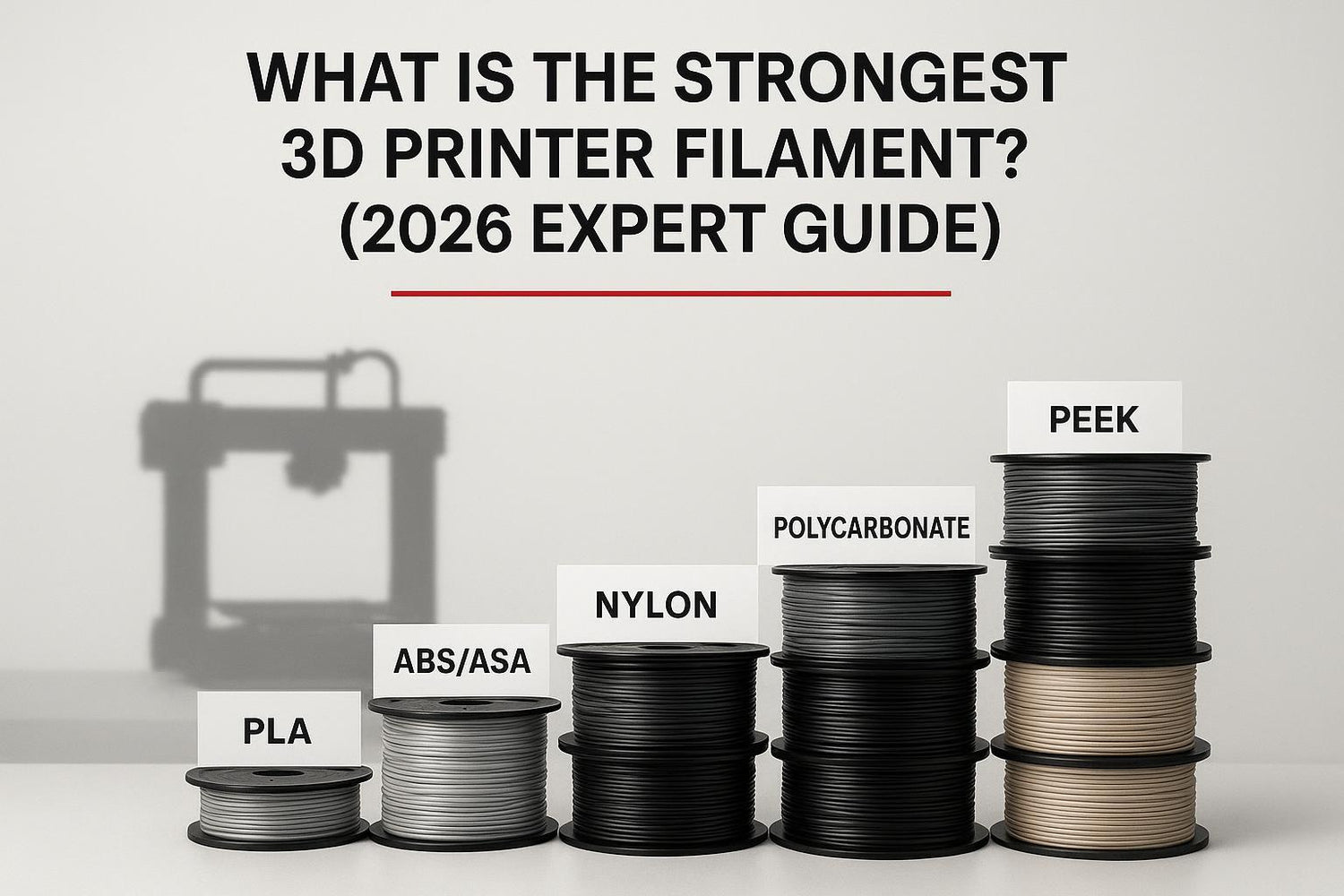
If you search “strongest 3D printer filament,” you’ll usually get a misleading list (materials you can’t print) or a single-number comparison (usually tensile strength) that doesn’t match how parts fail.
A better rule:
The strongest filament is the one that matches your failure mode (snapping, cracking, bending, or softening from heat) and is printable on your setup.
What “strongest” actually means for 3D prints
For printed parts, “strong” can mean four different things:
- Tensile strength: how much pulling force it takes to break.
- Impact toughness: whether it survives drops and sudden hits.
- Stiffness (modulus): how much it resists bending.
- Heat resistance: whether it keeps its shape near heat.
And there’s a fifth factor that often matters more than the material chart:
Layer bonding: FDM parts are typically strongest along the layer lines and weaker between layers (the Z direction). That’s why print settings and orientation can beat a “better” filament.
Strongest 3D printer filament: absolute strongest vs realistic strongest
Here’s the honest ranking, simplified for beginners.
|
Category |
Top candidates |
What they’re best at |
Beginner reality check |
|---|---|---|---|
|
Absolute strongest (industrial) |
PEEK (often sold as PEEK filament), PEI/ULTEM-class polymers; premium composites |
High performance in harsh heat/chemicals |
Often requires specialized high-temp hardware and tight process control (see Protolabs’ overview of strongest 3D printing filaments) |
|
Strongest you can realistically print |
Polycarbonate (PC) and nylon (PA) |
Durable functional parts when printed correctly |
Moisture + warping are the main enemies |
|
Strong and beginner-friendly |
PETG (and sometimes ASA) |
Great “first functional filament” behavior |
PETG’s heat limit and ASA’s warping/fume management are the tradeoffs |
Polycarbonate vs nylon 3D printing: which is “stronger” for your part?
If you’re buying your first “strong” engineering-ish filament, this decision is more useful than chasing exotic materials.
Choose polycarbonate when stiffness and heat matter
PC is a good fit for:
- rigid brackets and mounts
- parts that shouldn’t flex much under load
- parts that sit near warmth (electronics enclosures, motor mounts)
In Sovol’s comparison of common materials, polycarbonate is positioned as a top “strong common plastic,” with tensile strength cited up to about 9,800 psi (≈68 MPa) (Sovol’s guide to strength of common 3D printing filaments).
The catch: PC is more sensitive to warping and cracking when it cools too quickly.
Choose nylon when toughness and “won’t snap” behavior matter
Nylon tends to shine when you need:
- clips, latches, and parts that take hits
- moving or wearing parts (gears, bushings, guides)
- parts that flex repeatedly without cracking
The catch: nylon is hygroscopic. Wet nylon prints can look fine but end up weaker and more brittle than you expected.
Where carbon fiber blends actually help (and where they don’t)
Carbon fiber filled blends (like carbon fiber nylon filament) are usually chosen for stiffness and dimensional stability, not because they’re magically tougher.
Two practical implications:
- They can be great when your part fails by bending or needs to stay flat and precise.
- They can be a worse choice for impact-heavy parts, because “stiffer” can also mean “more brittle,” depending on the formulation.
Also: fiber-filled filaments are abrasive, so nozzle choice matters. Prusa’s material guidance calls out composite filaments as a special category for that reason (Prusa’s filament material guide).
How to make almost any filament print stronger
Before you spend money on a new spool, try these. They’re the difference between “this filament is weak” and “my part is weak.”
1) Rotate the part so layers aren’t the failure plane
If the load pulls across layers, you’re mostly testing layer bonding. If you align the part so the load runs along the layers, the same material can feel dramatically stronger.
2) Add walls before you crank infill
For functional parts, perimeters (walls) usually do more than infill.
A simple starting point:
- 4 walls for load-bearing parts
- moderate infill (often 20–40%) unless you need extra stiffness
If you’ve ever printed a bracket that snapped at the screw hole, this is why walls matter: you’re strengthening the outer shell that actually carries the load. Going from 2 walls to 4 often helps more than jumping from 20% to 60% infill.
3) Dry filament when strength matters
Moisture can create bubbles/voids that hurt layer bonding—especially for nylon and PC.
Sovol’s drying guide gives usable ranges beginners can start from:
- Nylon: about 80–90°C for 4–24 hours
- PC: about 85–120°C for 4–8 hours
- PETG: about 55–70°C for 4–8 hours
(common filament drying temperatures)
4) Use an enclosure when warping and cracking are your main failure mode
If you’re printing ABS/ASA, nylon, or PC and you’re seeing corner lift or layer splitting, a stable environment can matter more than the filament brand.
Sovol’s enclosure overview summarizes the key benefit well: keeping temperature steady helps reduce warping/cracking and can improve layer adhesion—especially with materials like ABS/ASA, nylon, and PC.
A low-regret “first strong filament” order
If you’re new and you want stronger functional parts without turning your hobby into a materials science project:
- PETG (best first upgrade from PLA for many people).
- ASA if you need outdoor durability and more heat tolerance than PETG.
- Nylon (PA) if you can commit to drying and want toughness.
- Polycarbonate (PC) if you can run hot and keep temperature stable.
FAQ
Is PLA the strongest 3D printer filament?
PLA can score well on tensile strength charts, but it’s often not the strongest in practice because it tends to be more brittle and less heat resistant than PETG, ASA, nylon, or PC.
What’s the strongest filament for 3D printing that most people can actually print?
For many consumer setups, nylon (PA) and polycarbonate (PC) are the top tier—if you control moisture and warping.
Is carbon fiber filament always stronger?
Not always. Many carbon fiber blends are stiffer, but not necessarily tougher—and they can be more brittle depending on the base polymer.
Next steps
If you want a deeper list of “strongest” materials (including high-end options like PEEK) plus printability caveats, see Sovol’s internal roundup (strongest filament for 3D printing).
For a broader view of typical strength ranges and how print behavior changes those numbers, Wevolver’s strength chart is a useful reference (filament strength vs toughness vs print behavior).
