
Stringing, raue Oberflächen und brüchige Drucke werden oft vorschnell mit Slicer-Einstellungen bekämpft. Dabei liegt die Ursache häufig schon auf der Spule: Das Filament hat Feuchtigkeit aus der Luft aufgenommen.
Ein Filamenttrockner kann den Materialfluss stabilisieren und die Druckqualität verbessern. Doch nicht jede Trockenbox heizt aktiv – und nicht jedes günstige Gerät erreicht die Temperatur, die du für TPU, PETG oder technische Filamente brauchst. Dieser Guide zeigt dir, worauf du beim Kauf einer Filament-Trockenbox unter 100 € achten solltest.
Kurzentscheidung: Trockenbox oder Filamenttrockner?
| Lösung | Aufgabe | Geeignet für |
|---|---|---|
| Passive Trockenbox | Trockenes Filament trocken lagern | PLA und bereits getrocknete Spulen |
| Beheizter Filamenttrockner | Feuchtigkeit aktiv aus dem Filament entfernen | PETG, TPU und regelmäßig genutzte Spulen |
| Haushaltsbehälter mit Trockenmittel | Günstige Langzeitlagerung | Mehrere Spulen im Regal |
Die wichtigste Regel: Trockenmittel kann eine trockene Spule trocken halten. Stark feuchtes Filament benötigt Wärme und Luftaustausch, damit die gespeicherte Feuchtigkeit tatsächlich entweichen kann.
Woran erkennst du feuchtes Filament?
Feuchtigkeit zeigt sich nicht bei jedem Material gleich. Typische Warnzeichen sind:
- Knistern oder kleine Dampfblasen an der Düse
- Stärkeres Stringing trotz plausibler Temperatur und Retract-Werte
- Raue, ungleichmäßige Oberfläche
- Schwankende Extrusion und kleine Lücken
- Schlechtere Layerhaftung oder spröde Bauteile
Bevor du dein gesamtes Slicer-Profil veränderst, trockne eine kleine Menge Filament und drucke dasselbe Testmodell erneut. Wird die Oberfläche sichtbar besser, war Feuchtigkeit wahrscheinlich ein wesentlicher Teil des Problems.
Welche Filamente brauchen besonders viel Aufmerksamkeit?
Alle FDM-Filamente können Feuchtigkeit aufnehmen, aber manche reagieren schneller oder deutlicher.
| Material | Feuchtigkeitsempfindlichkeit | Praxisempfehlung |
|---|---|---|
| PLA | niedrig bis mittel | Luftdicht lagern; bei auffälliger Extrusion trocknen |
| PETG | mittel | Nach dem Öffnen zügig wieder trocken lagern |
| TPU | mittel bis hoch | Bei längeren Drucken direkt aus dem Trockner zuführen |
| ABS/ASA | mittel | Trocken lagern; vor wichtigen Drucken prüfen |
| PA/Nylon | sehr hoch | Aktiv trocknen und während des Drucks geschützt halten |
Die genaue Trocknungstemperatur und -dauer hängt vom Hersteller und von der Materialmischung ab. Nutze immer die Angaben auf der Spule oder im technischen Datenblatt. Eine zu hohe Temperatur kann Spule oder Filament verformen.
7 Kaufkriterien für eine Filament-Trockenbox unter 100 €
1. Einstellbarer Temperaturbereich
Ein Gerät mit fester, niedriger Temperatur reicht möglicherweise für PLA, ist aber für TPU oder PETG weniger flexibel. Ein regelbarer Bereich erlaubt dir, die Wärme an das Material anzupassen.
2. Gleichmäßige Luftzirkulation
Wärme allein genügt nicht. Die Luft sollte sich um die Spule bewegen können, damit Feuchtigkeit nicht nur an einer Stelle entweicht. Eine durchdachte Luftführung ist daher wichtiger als eine möglichst hohe Wattzahl auf dem Datenblatt.
3. Möglichkeit, während des Trocknens zu drucken
Für TPU und Nylon ist ein abgedichteter Filamentausgang besonders praktisch. Das Material bleibt bis zum Extruder geschützt und nimmt während eines langen Druckjobs weniger neue Feuchtigkeit auf.
4. Leicht laufende Spulenführung
Die Spule muss sich ohne Ruckeln abrollen. Zu viel Widerstand kann zu Unterextrusion führen, besonders bei weichem TPU. Prüfe außerdem, ob breite oder schwere Spulen in das Gehäuse passen.
5. Timer und klare Bedienung
Ein Timer verhindert unnötigen Dauerbetrieb. Materialprogramme sind bequem, sollten dich aber nicht davon abhalten, die Vorgaben des Filamentherstellers zu prüfen.
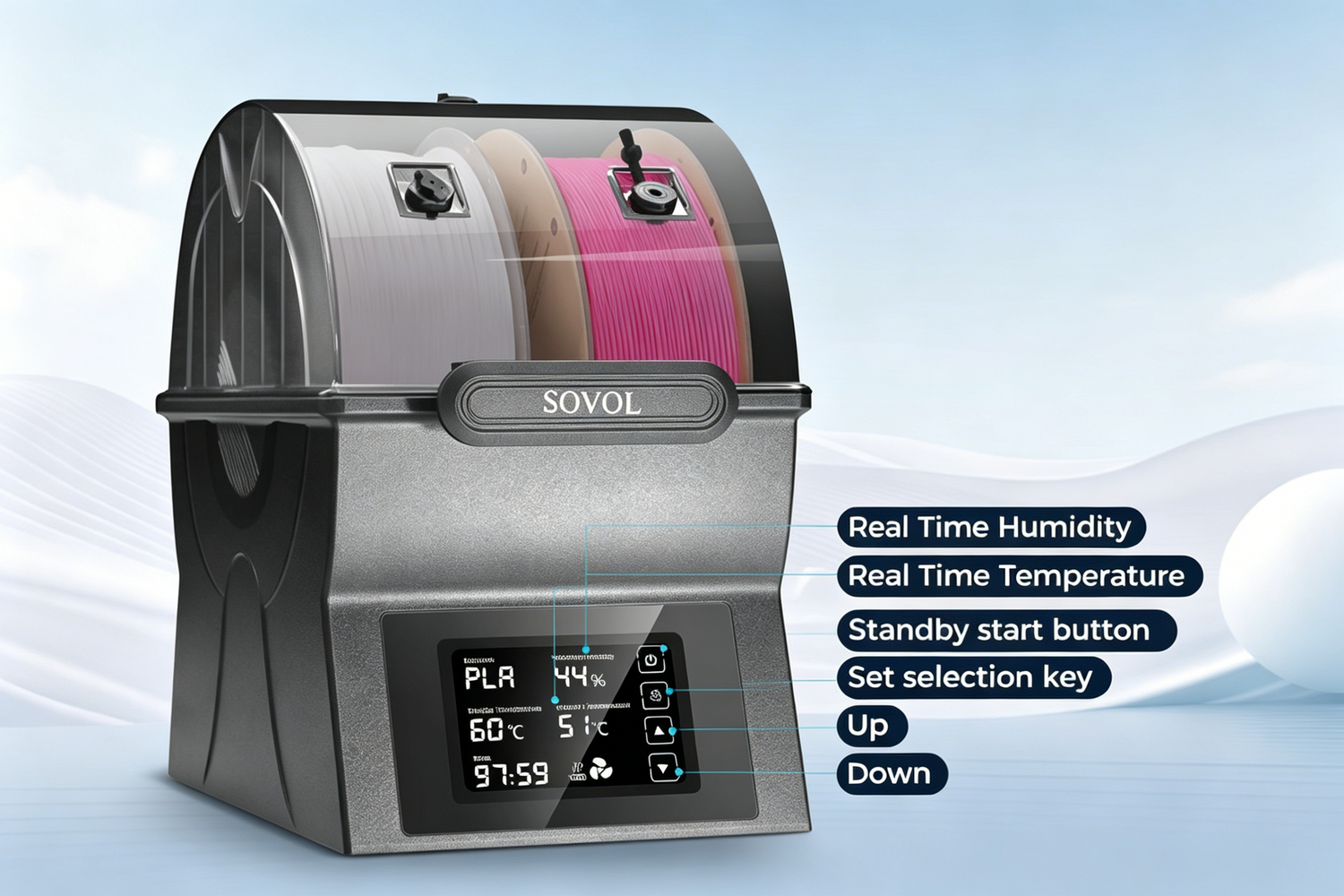
6. Temperatur- und Feuchtigkeitsanzeige
Eine Anzeige hilft dir, den Prozess zu überwachen. Beachte jedoch: Die Luftfeuchtigkeit im Gehäuse ist nicht dasselbe wie die Restfeuchte im Inneren des Filaments. Entscheidend bleibt der anschließende Testdruck.
7. Sicherheit und stabiler Stand
Ein Trockner läuft über mehrere Stunden. Stelle ihn auf eine feste, hitzebeständige Fläche, halte Lüftungsöffnungen frei und beachte die Bedienungsanleitung. Verwende keine improvisierten Heizlösungen ohne geeignete Temperaturregelung.
DIY-Trockenbox oder beheizter Filamenttrockner?
Eine DIY-Box aus einem luftdichten Behälter, Trockenmittel, Rollen und einem PTFE-Anschluss ist günstig und hervorragend für die Lagerung. Sie kann aber bereits feuchtes Filament meist nicht zuverlässig regenerieren.
- DIY-Box wählen: wenn du viele bereits getrocknete Spulen günstig lagern möchtest.
- Beheizten Trockner wählen: wenn du regelmäßig TPU, PETG oder feuchte Spulen verarbeitest.
- Beides kombinieren: Filament aktiv trocknen und anschließend in einer größeren, passiven Box lagern.
Sovol SH02: sinnvoller Allrounder für den EU-Workflow
Der Sovol SH02 Filament Dryer ist für Nutzer interessant, die mehr als eine einfache Aufbewahrungsbox benötigen. Er bietet einen einstellbaren Temperaturbereich von 40 bis 70 °C und ermöglicht die direkte Filamentzuführung während des Trocknens.
Damit eignet er sich besonders für häufig verwendete Materialien wie PETG und TPU. Der aktuelle Shoppreis liegt bei 59,99 € (Stand Juli 2026; Preise und Aktionen können sich ändern).
Für reine PLA-Lagerung kann eine günstige passive Box ausreichen. Wenn du jedoch regelmäßig Druckfehler durch feuchtes Material diagnostizierst oder lange TPU-Drucke planst, ist ein beheizter Trockner meist die praktischere Lösung.
So nutzt du einen Filamenttrockner richtig
- Prüfe Materialtyp und Herstellerangaben.
- Wähle eine sichere Temperatur unterhalb der Verformungsgrenze von Filament und Spule.
- Lasse die Luftwege im Gerät frei.
- Trockne lange genug, statt nur kurz stark zu erhitzen.
- Drucke ein kleines Vergleichsmodell.
- Lagere die Spule danach luftdicht mit regenerierbarem Trockenmittel.
Wenn du TPU druckst, findest du passende Startwerte für Temperatur, Geschwindigkeit und Retract in unserem TPU Filament Guide.
Fazit: Was lohnt sich unter 100 €?
Für trockene PLA-Spulen ist eine gut abgedichtete Lagerbox oft die wirtschaftlichste Lösung. Sobald du jedoch TPU, PETG oder stark feuchte Spulen verwendest, bietet ein beheizter Filamenttrockner den größeren Nutzen.
Achte nicht nur auf die Maximaltemperatur. Einstellbarkeit, Luftführung, ein sauberer Filamentausgang und leicht laufende Spulen entscheiden darüber, ob das Gerät deinen Druckalltag wirklich verbessert.
Feuchtes Filament kostet Druckzeit und Material
Der Sovol SH02 trocknet Filament bei einstellbaren 40–70 °C und versorgt deinen Drucker direkt aus der geschützten Box.
