


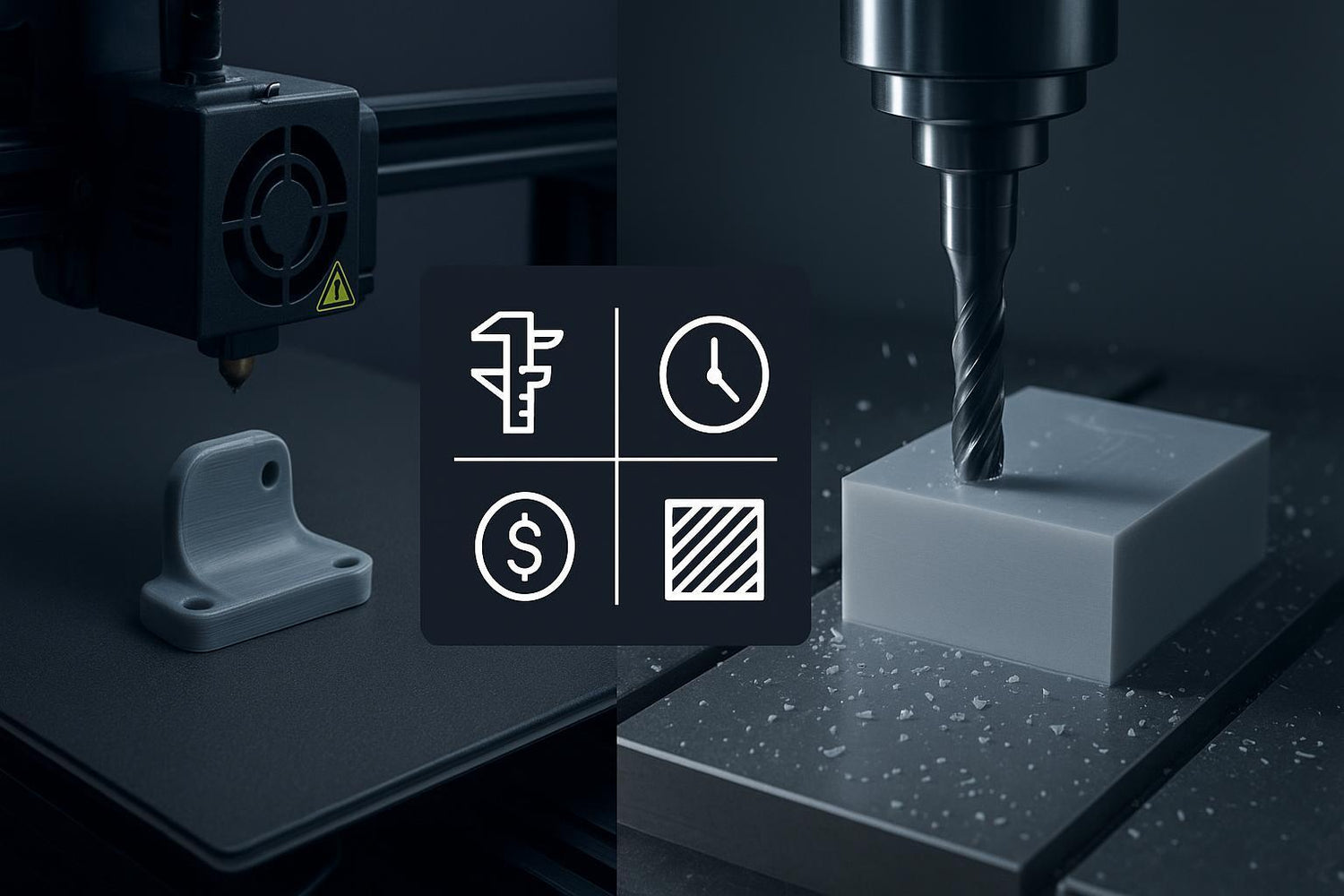
If you're making 10–200 functional ABS parts and you're deciding between FDM 3D printing and CNC machining, the right answer usually comes down to one question:
Are you optimizing for iteration speed and geometry freedom… or for precision, finish, and predictable mechanical behavior?
This isn't a "which is better" post. It's a decision framework for product designers building small parts (shoebox-size or smaller) where moderate tolerances and real-world use matter.
A Quick Comparison Matrix
| What you care about most | FDM 3D printing in ABS (typical) | CNC machining in ABS (typical) |
|---|---|---|
| Dimensional accuracy and tight fits | Often limited by shrink/warp and process variability; best for "tolerance by iteration" | Strong default choice for mating features and controlled fits |
| Strength in all directions | Direction-dependent (anisotropic); orientation and process control matter | Close to bulk material behavior (isotropic) |
| Surface finish on functional interfaces | Layer lines are inherent; smoothing adds variability | Better out of the gate; predictable finishing options |
| Complex internal geometry | Strong advantage (channels, lattices, one-piece assemblies) | Limited by tool access; complexity can drive setups/cost |
| Lead time for first parts | Fast if you already have a dialed ABS setup | Fast for many simple parts, but setup/programming is real |
| Cost drivers at 10–200 pcs | Machine time per part + post-processing per part | Setup + programming + fixturing, then efficient batch machining |
| Repeatability across 200 pcs | Possible, but you must control environment and process tightly | Generally easier to control, with fewer variables |
3D Printing vs CNC for ABS Parts: Tolerances and Mating Features
Here's the uncomfortable truth: for functional assemblies, tolerances aren't about what you "hope" a process can do — they're about what you can specify and repeatedly hit.
For FDM, many services describe tolerance as a percentage with a minimum floor. Xometry's overview of 3D printing tolerances (2025) notes a common desktop FDM expectation around ±0.5% with a lower limit of ±0.5 mm, with industrial systems tighter.
For CNC, Protolabs' guidance on fine-tuning tolerances for CNC machined parts (last updated 2026) discusses a typical baseline tolerance and how cost rises as you tighten requirements.
What that means in practice:
- If your ABS part has holes that locate pins, bearing seats, or two parts that must slide without binding, CNC is usually the safer default.
- If your part is closer to a protective housing, bracket, fixture body, or ergonomic prototype where ±0.2–0.5 mm isn't a deal-breaker, FDM can work — especially if you'll measure a first batch and adjust CAD.
Pro Tip: If you're considering FDM for parts with critical interfaces, design the part so the critical feature can be made "secondary" (reamed hole insert, heat-set insert, or a machined datum surface), and let FDM handle the rest.
Strength and Anisotropy
Machined ABS behaves like the bulk material. FDM ABS behaves like a laminated composite: it can be quite strong in-plane, and much weaker across layers, depending on print orientation and bonding.
- FDM parts generally aren't equally strong in all directions, which is why orientation matters for load-bearing designs (Formlabs explains this in their discussion of isotropy vs anisotropy in 3D printed parts).
- If the part sees tensile loads or peel-like loads that try to split layers apart, CNC (or a different additive process) is hard to beat.
Design moves that make FDM ABS more viable for functional parts:
- Put primary tensile loads in the XY plane (so you're not relying on layer adhesion).
- Use generous fillets and avoid thin, tall walls.
- Add mechanical fasteners where you'd otherwise rely on layer bonding.
Surface Finish and Functional Interfaces
If the part has sliding contact, sealing surfaces, or you care about predictable friction, CNC is the cleaner choice.
- Sanding and filling are labor-heavy and inconsistent across a batch.
- ABS can be vapor smoothed, but smoothing can change dimensions.
One study examining acetone vapor smoothing's effect on geometric accuracy (2022) reports dimensional deviation varies with wall thickness and exposure time.
Geometry: Where Each Process Actually Wins
Don't choose 3D printing because it's "cheaper." Choose it because it lets you design a part you couldn't reasonably machine.
When FDM ABS Tends to Win
- Internal channels that would require multi-part machining and assembly
- Consolidating multiple parts into one
- Fast design iterations (especially early in development)
Hubs' FDM design guidance summarizes common limits like the 45° overhang rule for FDM printing and why orientation is part of the design.
When CNC ABS Tends to Win
- Deep, precise holes and bores
- Flatness, perpendicularity, and datum control
- Clean internal corners/radii that match tool paths
Xometry's best practices on optimizing internal corner radii for CNC show why sharp internal corners drive small tools, slower machining, and higher cost.
Lead Time and Iteration Speed
There are two timelines to think about:
- Time to first part
- Time to a batch you trust
FDM can be extremely fast to first part if you already have ABS dialed in. Prusa's ABS guide calls out the need for a controlled environment (see the Prusa ABS material guide, updated 2026).
Cost Drivers (and Why "Break-Even" Isn't a Single Number)
For 10–200 units, cost is usually not "material vs material." It's setup vs time.
- FDM cost scales with print time per part and post-processing per part.
- CNC cost includes programming, setup, and fixturing, then a more efficient per-part run.
Hubs has a clear baseline comparison in 3D printing vs CNC machining (updated 2026). The designer's cost lever you control most: don't tolerance everything tightly — put tight tolerances only where they matter functionally.
Repeatability and QA for 10–200 Parts
At 10 parts, you can get away with heroics. At 200, you need a process.
For FDM ABS, repeatability usually depends on controlling:
- enclosure temperature / drafts
- bed adhesion consistency
- filament handling (dry storage)
- orientation consistency
For CNC, repeatability is typically easier to formalize:
- same stock material
- same toolpaths
- same fixturing
- inspection plan
The Hybrid Answer Is Often the Best One
If your part is "mostly fine" for FDM but has one or two critical features, consider a hybrid approach:
- Print the body in ABS.
- Machine only what must be machined (datums, bores, sealing faces).
This also makes your design more robust to supplier changes, because you're not relying on a single process to do everything.
Who Should Choose Which (for Small ABS Parts, 10–200 pcs)
Choose FDM 3D printing in ABS when:
- your part has geometry that would be annoying or expensive to machine
- your tolerances are forgiving, or you can iterate on fit
- you need parts fast and you already have ABS process control
Choose CNC machining in ABS when:
- you have mating features that must fit predictably
- you need consistent strength in all directions
- surface finish matters for function
If you can't tolerate a ±0.3–0.5 mm surprise on a critical feature, default to CNC.
Next Steps (If You're Evaluating FDM for ABS)
If your part looks like a fit for FDM, the fastest way to de-risk ABS is to control the printing environment (enclosure/draft prevention) before you try to "tune your way out" of warping.
If you're exploring printer options, you can browse examples like the Sovol SV08 or larger-format options like the Sovol SV08 Max, and use this enclosure primer as context: enclosed vs open 3D printers.
FAQ
Is FDM ABS "Functional" Enough for End-Use Parts?
Sometimes. It depends on whether your part's function is limited by strength direction, surface finish, or dimensional control. If your part mainly sees compressive loads and tolerances are forgiving, it can work. If it needs tight fits or sees peel/tensile loads across layers, CNC is often safer.
What Tolerances Should I Assume for FDM ABS?
A realistic starting point is to assume FDM will need clearances and iteration rather than expecting machined-like fits. For service-style guidance, see Xometry's explanation of 3D printing tolerances (2025).
Can Acetone Vapor Smoothing Fix Layer Lines Without Affecting Fit?
It can improve surface finish, but it can also change dimensions. If fit matters, test it on your geometry first and leave tolerance budget for the process; see the acetone vapor smoothing geometric accuracy study.
