
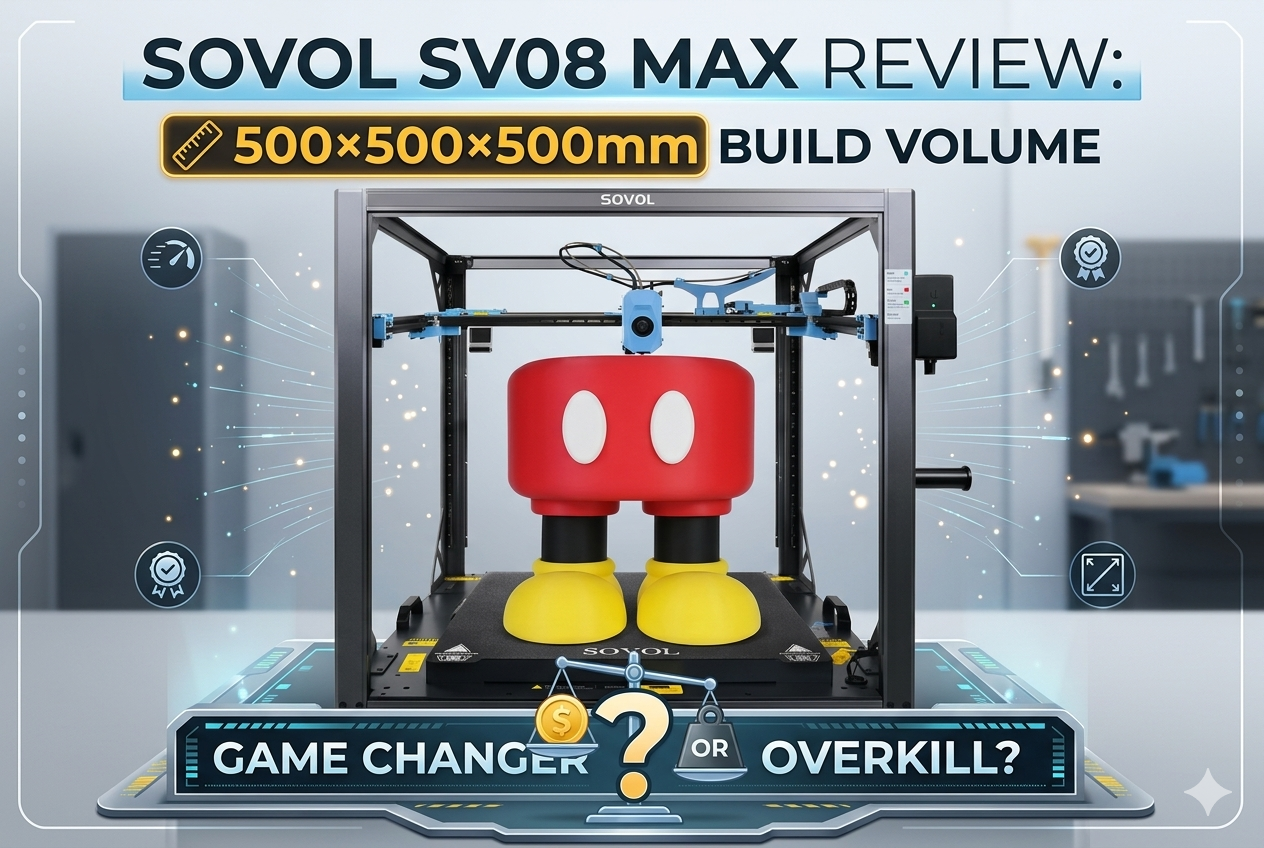
If you build cosplay props, you already know the real tax isn’t filament—it’s seams.
A normal-size printer can make great helmets, chest plates, and blades… as long as you’re willing to split the model, align it, glue it, reinforce it, fill it, sand it, prime it, sand it again, then pretend you enjoyed the process.
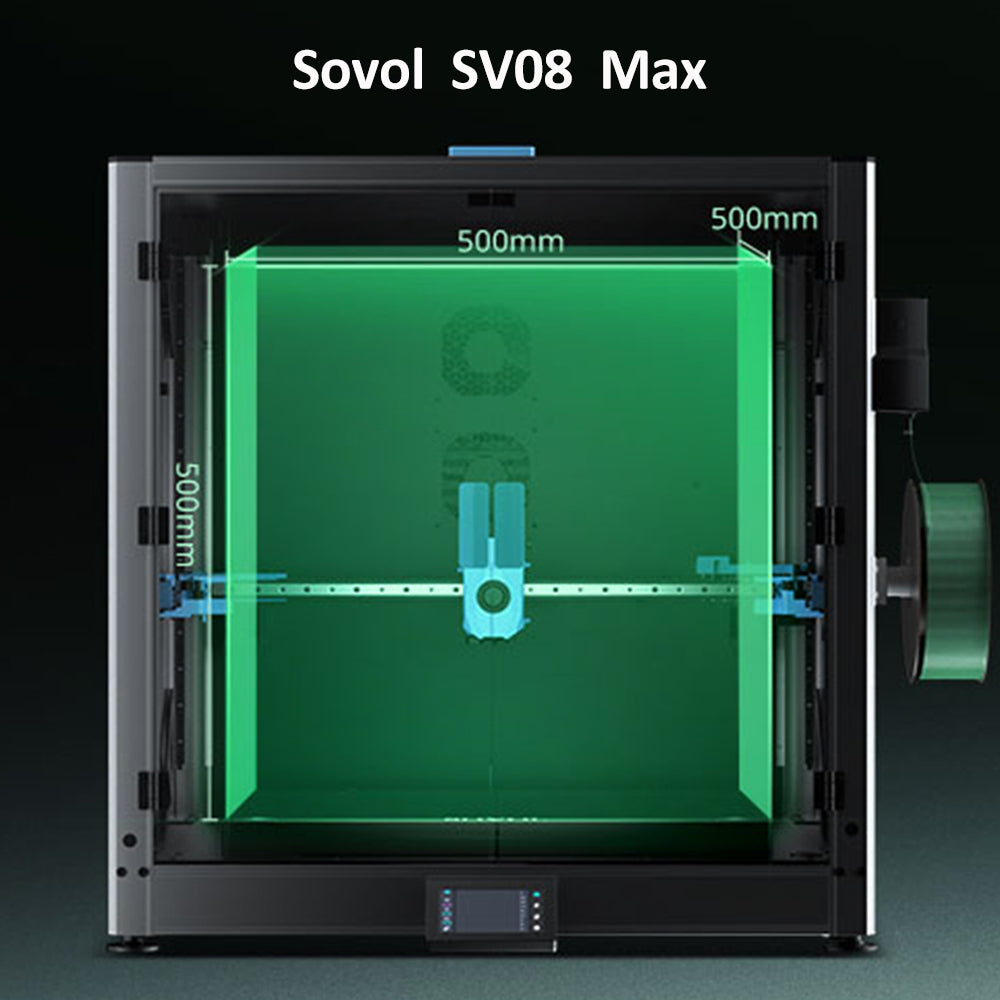
So when a printer shows up with a 500×500×500mm build volume, it’s tempting to think: “Finally. One-piece prints.”
Here’s the honest verdict.
Verdict: buy it if you’re tired of seams and you can feed the machine
The Sovol SV08 Max makes sense for cosplay/props makers when you’ll actually use that 500mm volume for big shells (helmets, armor sections, large weapons, big scenic pieces) and you have the space and patience for long prints.
If you mostly print small parts, detail-heavy greeblies, or you don’t have room for a large machine footprint, the SV08 Max is more likely to feel like overkill—and a smaller, dialed-in printer plus smarter model splitting will get you 90% of the benefit.
This isn’t a “one printer for everyone” situation. Large format changes your workflow in good ways and annoying ways.
Who the SV08 Max is for (cosplay edition)
You’re a strong fit if you regularly:
- Print helmet shells (or want to stop slicing them into 6–12 pieces)
- Print armor plates where seams land in the worst possible places
- Print large props (swords, hammers, blasters) and want fewer structural joints
- Run multi-part batches (multiple armor pieces in one job) and you can tolerate longer print windows
You should probably skip (or wait) if:
- Your work is mostly small, high-detail parts where a smaller nozzle and tighter tolerances matter more than volume
- You don’t have a stable place for a large printer (wobbly tables and large CoreXY builds don’t mix)
- You can’t realistically monitor multi-day prints
- Your material plans rely heavily on ABS/ASA but you don’t want to budget for enclosure/temperature control
The 500×500×500mm question: when it’s worth it
A 500mm cube is valuable for cosplay in three specific ways.
1) You print bigger “skins” in one go
The obvious win: one-piece helmet shells and large armor panels. Fewer seams usually means:
- Less time aligning and gluing
- Fewer weak points (especially on wearable parts that flex)
- Cleaner geometry (you’re not fighting a seam right across a curve)
If you’ve ever lost an evening to seam work, you understand why build volume is a feature—not a flex.
2) You choose better seam placement (when you still split)
Even with 500mm, you’ll still split some models. The difference is you can split for convenience, not because the printer forced you.
That means you can place seams where you can hide them:
- Under raised details
- Along natural armor “panel lines”
- On flat backing surfaces
3) You batch-print more parts per run
Large beds let you print multiple pieces in one job. That’s a productivity boost if your workflow is stable.
But batching has a dark side: one failure can nuke an entire bed. For big cosplay jobs, reliability is the real feature.
Specs that actually matter for large props (and what they mean in practice)
Here are the SV08 Max specs you should care about for cosplay—pulled from the official pages so you can sanity-check them.
Build volume: 500×500×500mm
Sovol lists the SV08 Max build volume as 500×500×500mm on the official product page, and notes 500×500×450mm with the enclosure kit installed.
That second number matters. If you’re thinking “enclosure + tall helmets,” make sure your tallest builds still fit once you plan to enclose.
Reference: Sovol EU “SV08 Max 3D Printer” page.
Motion + control: CoreXY + Klipper
The SV08 Max is a CoreXY machine with Klipper control listed on the official spec sheet.
For cosplay makers, the benefit isn’t “I can print at 700mm/s.” It’s that a CoreXY + Klipper setup tends to:
- Keep the bed’s mass out of the fast axis motion (helpful for tall parts)
- Make high-acceleration moves possible without instantly turning your printer into a maraca
- Give you access to tuning tools (input shaping, pressure advance) that can improve results when you’re pushing speed
Official references: SV08 Max specs on Sovol EU and SV08 Max specs on Sovol US.
Speed, acceleration, and flow: treat the “max” numbers as capability, not promise
Sovol lists up to 700mm/s max speed, 40,000mm/s² max acceleration, and 50mm³/s max flow on the SV08 Max spec sheet.
Those numbers tell you the machine is designed for high throughput. They do not guarantee your 500mm helmet will look great at those settings.
For cosplay work, you’ll usually trade top speed for:
- Cleaner outer walls (less ringing)
- Better layer bonding
- Lower risk on long jobs
Official reference: SV08 Max official specifications.
Temperatures: nozzle up to 300°C, bed up to 100°C
Sovol lists a ≤300°C nozzle and ≤100°C bed.
That supports common cosplay materials like PLA, PETG, TPU, and (with the right setup) ABS/ASA—though large ABS/ASA is less about “can the nozzle hit temp” and more about environmental control.
Official reference: Sovol EU “SV08 Max 3D Printer” page.
Leveling: eddy current scanning
Sovol highlights eddy current scanning for contactless bed leveling.
On a 500mm bed, leveling is not a “nice to have.” It’s the difference between:
- a first layer that holds across the full plate
- and a slow-motion failure that starts at hour 6
Official reference: SV08 Max specs on Sovol EU.
Camera + remote monitoring
The SV08 Max lists a built-in 1280×720 camera with remote monitoring and Obico integration.
For cosplay printing, the camera matters because long prints fail for boring reasons:
- a corner starts lifting
- a support breaks
- filament tangles
Catching that early is cheaper than “discovering it tomorrow.”
Official reference: SV08 Max specs on Sovol EU.
What large-format printing changes in your cosplay workflow
The best way to think about a 500mm printer is this: it doesn’t eliminate work—it moves work around.
You trade seam work for print management
One-piece prints reduce seam work, but you’ll spend more time on:
- dialing in first-layer consistency across a huge bed
- managing long print windows
- choosing nozzle/layer settings that don’t turn finishing into a punishment
If you enjoy finishing more than babysitting prints, large format is a win.
If you hate long prints more than you hate seams, it’s a wash.
You can print “draft” shells faster and finish smarter
Most cosplay props get sanded, filled, and painted anyway. That means ultra-fine layer heights aren’t always the best use of time.
A common approach is to use a larger nozzle and thicker layers to shorten print time, then use filler primer and sanding to get the surface you want.
Prusa’s nozzle guide notes a practical rule: layer height should not exceed ~80% of nozzle diameter (e.g., ~0.32mm max on a 0.4mm nozzle).
Reference: Prusa Research, “Everything about nozzles with a different diameter”.
A cosplay-focused slicer settings guide (use as a starting point, not gospel) also recommends moving up to a 0.6mm nozzle for props to reduce print time.
Reference: Nikko Industries’ slicer settings for cosplay props.
Pro tip: For big armor shells, try a larger nozzle (0.6mm) and a “draft” outer wall profile on a small test piece first. If the finish time drops without ruining details you care about, you’ve found your new default.
The real trade-offs (the part people don’t put in spec sheets)
A 500mm-class printer can be a joy. It can also be a space heater that prints anxiety.
Space and footprint are deal-breakers
Sovol lists the printer size as 700×710×750mm (excluding spool holder) on the product page. That’s before you account for:
- clearance around the machine
- filament handling
- enclosure footprint (if you add one)
Reference: SV08 Max specs on Sovol EU.
If your printer sits in a traffic area, large format will punish you. Bumping the table mid-print is a special kind of pain.
Power and heat management matter more when the bed is huge
Large beds require more energy to heat and keep stable. Sovol lists a 1300W hotbed on the SV08 Max page.
Reference: SV08 Max specs on Sovol EU.
That doesn’t mean it pulls 1300W constantly, but it does mean you should treat this as a “serious appliance,” not a toy.
Long prints amplify small problems
On small printers, you can get away with a slightly dirty bed or a questionable spool.
On a 500mm, multi-day print, that tiny issue becomes a full restart.
A third-party review of the SV08 Max calls out the big practical negatives you’d expect: space demands and high filament usage.
Reference: Twisted Prints 3D, “Sovol SV08 Max Review – A Giant 3D Printer for Big Ideas”.
⚠️ Warning: If you plan to print ABS/ASA at this size, expect warping to be the default failure mode until you control drafts and temperatures.
Do you need an enclosure for cosplay materials?
Not always.
- PLA: typically fine open-air, assuming your room isn’t drafty and you’re not pushing extreme speeds.
- PETG: often fine open-air, but you’ll still benefit from stable temps on huge prints.
- ABS/ASA: the larger the part, the more the material shrinkage punishes you.
Simplify3D’s ABS guide points out ABS contracts during cooling and is prone to warping without the right conditions.
Reference: Simplify3D “Ultimate Materials Guide: ABS”.
For large ABS parts specifically, Airwolf3D discusses raising bed temps for big prints to reduce warping at the base.
Reference: Airwolf3D, “6 Things You Should Know About 3D Printing Large ABS Parts” (2022).
If you want the enclosure option, Sovol sells an SV08 Max enclosure kit on the EU store.
Reference: SV08 Max enclosure kit.
How to get reliable big cosplay prints on a 500mm machine
This is where the SV08 Max either becomes your favorite tool—or an expensive lesson.
1) Treat the first layer like a preflight check
Before committing to a 20–60 hour job:
- Clean the build surface
- Run leveling/mesh
- Print a large first-layer test (not a tiny square in the corner)
On a big bed, “it worked last week” isn’t evidence.
2) Use nozzle and layer settings that minimize total project time
Total project time = print time + failure risk + finishing time.
A larger nozzle and thicker layers can reduce print time dramatically. The trade-off is more visible layer lines, but cosplay finishing often hides that.
Use the Prusa rule-of-thumb (layer height ≤ ~80% nozzle diameter) as a guardrail.
Reference: Prusa Research nozzle diameter guidance.
3) Pick materials based on heat exposure and finish goals
- PLA is easy, but can soften in hot cars or sun.
- PETG is often a practical middle ground for wearables.
- ABS/ASA can be great for heat resistance, but demands enclosure discipline—especially at large sizes.
4) Plan your monitoring strategy
If you’re going to run multi-day prints, the camera isn’t a gimmick. It’s your early-warning system.
If you need firmware files or manuals, Sovol maintains a hub on the EU site.
Reference: Sovol firmware and user manuals.
So… game changer or overkill?
It’s a “game changer” only in one specific way: it buys back your finishing time by letting you print big, clean shells with fewer seams.
But it’s overkill if you:
- don’t have the space
- don’t need one-piece shells
- aren’t prepared to run long prints like a process (bed prep, leveling, monitoring)
If your cosplay pipeline is dominated by seam work, the SV08 Max’s volume is hard to ignore.
If your pipeline is dominated by small details, you’ll be happier spending the money on quality, consistency, and material control—not cubic millimeters.
Next step
If the “who it’s for” section described you, start by reviewing the official specs and footprint to make sure you can actually live with a 500mm-class machine.
See the full details for the Sovol SV08 Max.
If ABS/ASA is part of your plan (or your workspace is drafty), look at the SV08 Max enclosure kit before you commit—large parts are where temperature stability stops being optional.
