

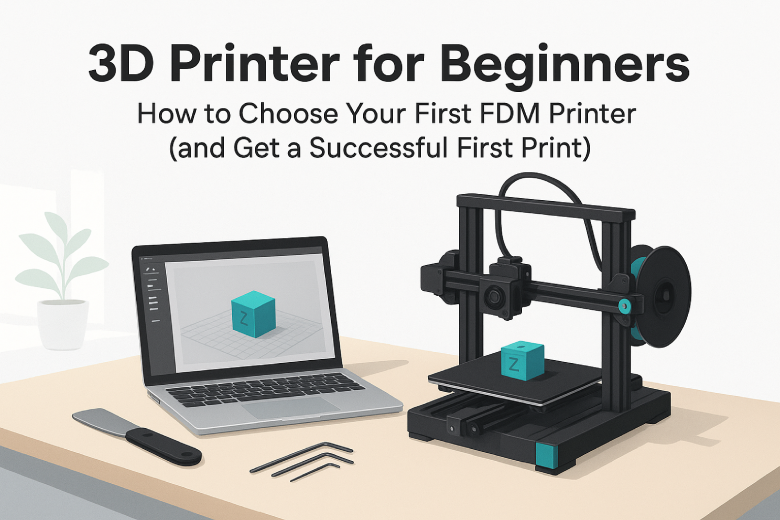
Buying your first 3D printer is exciting—right up until your first print peels off the bed, turns into spaghetti, and you start wondering if you accidentally bought a hobby that requires an engineering degree.
You didn’t. You just need two things:
- The right kind of printer for a first-time setup (for most people at home, that’s FDM)
- A short list of features that make first-layer success much more likely
This guide will help you choose a 3D printer for beginners without drowning in specs—and it’ll show you what your first week actually looks like so you know what you’re signing up for.
FDM vs resin: a 90-second sanity check
Before you compare brands and models, make sure you’re comparing the right technology.
- FDM (Fused Deposition Modeling) printers melt plastic filament (a solid spool) and lay it down layer by layer. They’re generally considered more beginner-friendly and are great for functional prints, organizers, and larger objects.
- Resin printers (often called MSLA/SLA) cure liquid resin with UV light. They can produce gorgeous detail, but they’re messier and require more careful handling and ventilation.
If you’re choosing a first printer for home use, FDM is usually the lowest-friction starting point—especially if you begin with PLA filament. UltiMaker’s comparison of resin vs FDM printing explains the trade-offs clearly. If you want the short version: start with FDM unless you specifically want miniature-level detail and you’re ready for the extra safety and cleanup steps.
If you want a deeper breakdown of beginner-friendly printing types, Sovol also has a helpful explainer: How to Choose the Right 3D Printing Type for Beginners.
The 7 features that matter most in a beginner-friendly FDM 3D printer
Most marketing spec sheets are optimized to impress, not to help you succeed. For your first printer, prioritize the features that reduce setup time and prevent the most common failures.
1) Auto bed leveling (and easy Z-offset)
If you learn one concept early, make it this: the first layer is everything.
Your printer’s nozzle has to be the right distance from the bed so the filament slightly “squishes” onto the surface. Too high and it won’t stick. Too low and it can scrape the bed or clog.
Auto bed leveling doesn’t magically fix everything, but it dramatically reduces how often you’ll fight the machine just to get a print started. Tom’s Hardware highlights auto-leveling as a core beginner-friendly feature in its best beginner printer criteria (2026).
Pro Tip: Even with auto leveling, you may still adjust Z-offset once. Think of leveling as “making the bed flat” and Z-offset as “setting the nozzle’s starting height.”
2) A build plate that’s easy to use (and easy to clean)
Beginner success often comes down to a clean, consistent surface.
Look for a plate that’s designed for adhesion and easy release (many people prefer textured spring-steel plates). Whatever surface you choose, you’ll want to clean it regularly—skin oils alone can reduce adhesion.
3) A heated bed (even if you start with PLA)
A heated bed helps prints stick during the early layers and reduces warping. You may not need a hot bed for every PLA print, but it’s one of those features you miss the moment you don’t have it.
4) A reliable extruder (direct drive is beginner-friendly)
The extruder is the mechanism that pushes filament into the hotend.
For beginners, the practical question isn’t “Bowden or direct drive?” so much as: Will filament feeding be consistent without constant tuning? Many modern beginner-friendly printers lean toward direct drive because it tends to handle a wider range of filaments more predictably.
5) Filament runout sensor (and ideally power-loss recovery)
A runout sensor pauses the print if the filament runs out or snaps. Power-loss recovery helps resume after a brief outage.
These features don’t make your prints prettier—but they prevent the most demoralizing kind of failure: a print that was 90% done. PCMag’s overview of what to look for in a 3D printer calls out platform/leveling, software, and practical usability features like these. (Also: if you see a printer that requires proprietary cartridges to run basic filament, think twice.)
6) A slicer ecosystem with solid default profiles
A slicer is the software that turns a 3D model into printer instructions (often called G-code). Great hardware can still produce bad prints if the slicer profile is poorly tuned.
For a first printer, look for:
- A slicer that’s actively maintained
- Default profiles that work well without deep tweaking
- A large user community (because you’ll Google a lot in week one)
7) “Home fit”: noise, footprint, and where it will live
This is the part most buying guides skip.
A printer you use beats a printer you own. Before you buy, decide:
- Where will it sit (desk, garage, spare room)?
- Can you tolerate the noise for long prints?
- Do you have space to access the back/sides for maintenance?
Raise3D’s guide on how to choose a 3D printer is broad, but it’s good for thinking through practical constraints like space, materials, and operations.
What your first week looks like (so you can choose confidently)
Here’s the beginner workflow in plain English:
- Unbox + assemble (some printers are mostly assembled; others are “weekend projects”)
- Run calibration (auto leveling, Z-offset, and a test pattern)
- Load filament (start with PLA)
- Slice a model in your slicer (use a default profile first)
- Print a simple test (calibration cube, benchy, or first-layer square)
- Adjust one thing at a time (speed, temperature, Z-offset)
If you want a longer walkthrough of what “getting started” looks like, Sovol has a beginner path that covers prep, calibration, and your first print.
The top 5 beginner mistakes (and the fastest fixes)
You can avoid weeks of frustration by treating these as your default checklist.
Mistake 1: Chasing “fast” instead of chasing “reliable first layers”
Speed specs are easy to market and hard to interpret. Your goal early on is repeatable success, not records.
If your first layer is messy, slow down the first layer and focus on adhesion.
Mistake 2: Touching the build plate with your fingers (then wondering why nothing sticks)
Skin oils reduce adhesion. Clean your plate periodically and avoid touching the print surface.
Mistake 3: Ignoring nozzle-to-bed distance
Many first-layer failures come down to the nozzle being slightly too high or too low.
A lot of first-layer problems come down to a slightly wrong Z-offset or a dirty plate—fix those first before you start changing ten slicer settings.
⚠️ Warning: Don’t “fix” adhesion by cranking the nozzle down until it scrapes. If you hear scraping, stop and recalibrate.
Mistake 4: Switching materials too early
PLA is popular for a reason: it’s forgiving.
Once you can print PLA consistently, then explore PETG or ABS with the right safety setup. Sovol’s FDM 3D Printing Filament Guide for Beginners is a solid next read.
Mistake 5: Printing in the wrong environment
Temperature swings, drafts, and cramped spaces can ruin prints.
Even with FDM, ventilation is still a good idea—especially if you move beyond PLA. The CDC/NIOSH post on safe 3D printing (2024) explains a “precautionary principle” approach that works well for home setups.
Basic safety for printing at home
You don’t need to be scared of 3D printing, but you should respect the risks.
- Heat & burns: hotends and heated beds can reach temperatures that cause burns.
- Moving parts: belts and gantries can pinch.
- Fire risk: like any device that runs hot for hours, build your setup to reduce risk.
Simple, high-impact habits:
- Place the printer on a stable, non-flammable surface.
- Keep the area clear of clutter (paper, sprays, loose filament, fabric).
- Don’t run your first few prints unattended.
- If your printer supports it, confirm thermal runaway protection is enabled (it helps shut things down if the heater behaves unexpectedly).
For a more formal overview, the University of Illinois published 3D Printer Safety guidance (2026) that covers hazards and controls in plain language. If you want a practical checklist-style doc, NIOSH’s Approaches to safe 3D printing (2024-103) is a strong reference.
Next steps: choose one “beginner path” and stick to it
If you’re overwhelmed, make your first goal boringly specific:
- Buy an FDM printer with auto leveling
- Print PLA
- Get a clean first layer
- Make three small, successful prints before you change anything major
If you want beginner resources from a brand that focuses on value-oriented, open-source machines, Sovol has a solid library of guides—start with their Fundamental Guide to 3D Printing, then use their How to Start with Open Source 3D Printers for Beginners walkthrough to get to your first successful print.
