






You want to print a flexible phone bumper, a soft contact pad or a sleeve that bends without breaking. Then you see three familiar labels: TPU 85A, 95A and 98A. Which one should you choose?
Among these nominal Shore A grades, 85A is the softer option, 95A sits between them and 98A is the firmer option. But the number does not describe the whole finished object. A thin 98A strip can bend more readily than a thick, solid part made from a softer formulation.
The practical choice comes from matching the material, part shape and printer—not simply choosing the lowest or highest number.
What do TPU and Shore A mean?
TPU stands for thermoplastic polyurethane, a family of thermoplastic elastomers. In filament form, it is used to make flexible and resilient FDM/FFF parts.
The number followed by A refers to the Shore A hardness scale. A standardized indentation test measures how strongly the material resists a small indenter. Higher readings on the same scale indicate greater indentation hardness.
It is not a percentage: 95A does not mean “95% hard,” and 98A is not simply “3% harder” than 95A. Hardness also differs from stretch, tensile strength, rebound, grip and resistance to permanent deformation.
Keep the letter when comparing products. Shore A and Shore D use different scales; their numbers cannot be ranked as if they were the same units.
85A vs. 95A vs. 98A at a glance
| Grade | Relative feel | When to consider it | Main check |
|---|---|---|---|
| 85A | Softer within this comparison. | A design that needs easier deformation. | Feed-path support and whether the part holds its shape. |
| 95A | Between 85A and 98A. | A balance of flexibility and shape retention. | Actual fit and flex in the intended geometry. |
| 98A | Firmer within this comparison. | A part that needs some give while staying relatively firm. | Whether it bends or compresses enough for the application. |
This is a directional comparison of nominal grades, not a measured ranking of every manufacturer's products. Compare technical data sheets and equivalent sample shapes before drawing conclusions.

85A TPU: when easier deformation matters
A softer grade is worth investigating when a part should yield readily. Examples include compliant sleeves, flexible covers and structures designed to compress. That does not mean every solid 85A print will feel like a soft cushion.
The trade-off is handling. A softer filament strand can buckle or compress in gaps around the drive gears or along a poorly constrained feed path. Confirm support for the specific grade before buying a spool.
Also check the finished design: a very compliant wall may fold, lose its fit or fail to provide the support you intended. Softer is useful only when that behavior matches the job.
95A TPU: a middle option to evaluate
95A can be a useful candidate when you want flexibility without immediately choosing either end of these three examples. Phone bumpers, protective covers and small contact pads are reasonable prototype projects.
It is not an automatic best choice. A thick bumper may be too stiff to install; a thin sleeve may be too flexible to retain its shape. Start with a representative sample rather than assuming the grade will settle those questions.
98A TPU: firmer parts with controlled give
98A is relatively firm within this comparison. Think of a part that should flex a little while keeping a defined form, rather than a soft, easily squeezed object.
Potential projects include protective corners, firm sleeves and pads for non-critical holders. Thin sections can still bend, while short, thick sections may be difficult to deform by hand.
A firmer strand can be easier to guide than a very soft one, but the rating does not guarantee reliable feeding, high-speed printing or compatibility with an automatic filament system.
Choose by the job, not just the number

A phone bumper or fitted cover
Consider how the rim must stretch or bend during installation, then how firmly it should stay in place. Wall thickness and openings deserve attention alongside hardness. Test the real fit; no generic TPU grade establishes a drop-protection rating.
A foot, pad or protective contact surface
Decide whether the part needs a small amount of compliance or substantial compression. Check it under the actual load and against the intended surface. Grip, vibration isolation and long-term compression behavior depend on the formulation and design.
A sleeve, model tire or flexible connector
Ask how far it must move, how often it will flex and whether it needs to recover its original shape. A hobby tire also depends on tread and material formulation, not simply the lowest hardness available.
For shoes or skin-contact items, hardness alone does not establish comfort or suitability. Application-specific material documentation and testing are needed.
Why shape can matter as much as hardness
Imagine using the same spool to print a thin strip, a compact block and an open frame. Their resistance to bending will be different even though the material has not changed.

- Thickness: thinner sections generally bend more readily than thicker sections of comparable shape.
- Length and geometry: long sections, curves and open structures respond differently from short, solid blocks.
- Wall count: outer walls can dominate the behavior of small parts.
- Infill and solid layers: the internal structure changes how a part compresses and bends.
- Orientation: layer direction affects bending and potential failure locations.
Lowering infill may make a printed structure easier to deform, but it does not turn 98A polymer into an 85A formulation. Similarly, a hardness reading on a sparse print is not automatically equivalent to a standardized material test.
Which TPU hardness is easiest to print?
Generally, a softer flexible strand demands more careful guidance. A short, well-constrained direct-drive feed path is often helpful; some Bowden arrangements can handle suitable grades, but a long or poorly supported path can make control harder.
Printer design, formulation, diameter, spool resistance, moisture and the profile all matter. Do not assume 98A prints at PLA speeds or that 85A works on every printer advertised as TPU-compatible.
Before buying, check:
- The exact grade and filament diameter supported by the printer and extruder.
- The recommended feeding route and any restrictions on automatic loading.
- A suitable material profile, including realistic flow and retraction settings.
- The supplier's drying instructions and spool temperature limit.
- Build-surface compatibility and any required release layer.
For setup details, see our TPU printing guide. Use the specific material's recommendations rather than copying one universal temperature or speed.
Does a firmer TPU work in an automatic feeder?
A hardness label is not a compatibility certificate. A printer hotend may support TPU while its automatic feeder does not support the particular strand.
Check the approved materials for the exact printer and feeding system. Use an external-spool route when specified. Do not treat a generic 98A product as equivalent to a specially approved feeder-compatible material.
Separate hotends also do not make every TPU compatible with every loading path. For a multi-material object, test adhesion and shared printing conditions in addition to feeding.
A simple way to find the right grade
- Define the movement: should the part bend for installation, compress under load or avoid hard contact?
- Choose a candidate: softer, intermediate or firmer within the grades your printer supports.
- Print a representative sample: use the planned thickness, walls and orientation.
- Evaluate after cooling: check fit, movement and recovery under a realistic controlled load.
- Change one variable: test geometry first or compare another grade using the same shape.
- Check repeated use: inspect for layer damage and permanent deformation, not just one successful bend.
This approach gives more useful information than matching a filament to a generic “rubber-like” analogy.
Keep moisture out of the comparison
TPU can absorb moisture, which may contribute to bubbles, rough extrusion and stringing. Follow the manufacturer's drying instructions and keep dried filament sealed with suitable desiccant. If using a dry box during printing, minimize resistance in the feed route.
For persistent threads between features, see our TPU stringing guide. Compare properly prepared materials so that moisture problems do not confuse your grade selection.
Frequently asked questions
Which is softer: 85A, 95A or 98A?
85A is the softer nominal Shore A grade among these three, followed by 95A and then 98A. Finished-part feel still depends on design and formulation.
Is 95A always the best starting point?
No. It is a middle option in this comparison, but the printer's supported materials and the required behavior should decide the starting point.
Can 98A still be flexible?
Yes. A thin section can bend while a thick section feels firm. Flexibility is not determined by the hardness number alone.
Will less infill replace a softer grade?
It can change structural compliance, but it does not change the material's nominal hardness. Test whether that structure meets the actual need.
Does a lower number mean better cushioning?
Not by itself. Thickness, structure, load and the material's compression and recovery behavior all matter.
Can I use one profile for every TPU grade?
Do not assume so. Start with the recommendations for the exact formulation and printer, then validate feeding, flow and the resulting part.
The right hardness is the one that suits the part
Consider 85A when easier deformation is the priority, 95A as an intermediate candidate and 98A when a firmer flexible structure is desirable. None is universally better.
Match the grade to the printer, design and use. A small sample with the intended geometry is the most practical next step.
Explore Sovol filaments and check the actual grades, diameters and material guidance on individual product pages. Collection availability should not be taken to mean that every TPU hardness is offered.
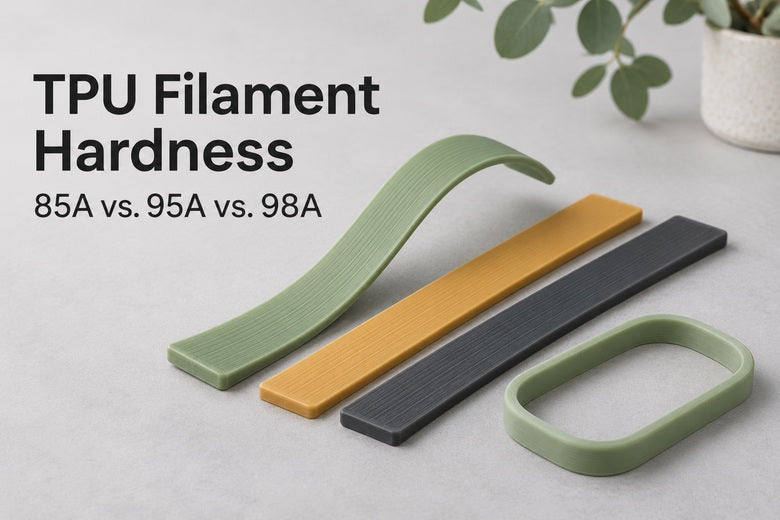
Images are conceptual illustrations of flexible parts and geometry. They do not show measured hardness comparisons, certified protection or a guaranteed bending response.
