
If you’ve ever peeled supports off a print and thought, “There has to be a cleaner way,” you’re not alone. Supports make ambitious models possible—but they also add cleanup time, leave marks, and sometimes snap the wrong part.
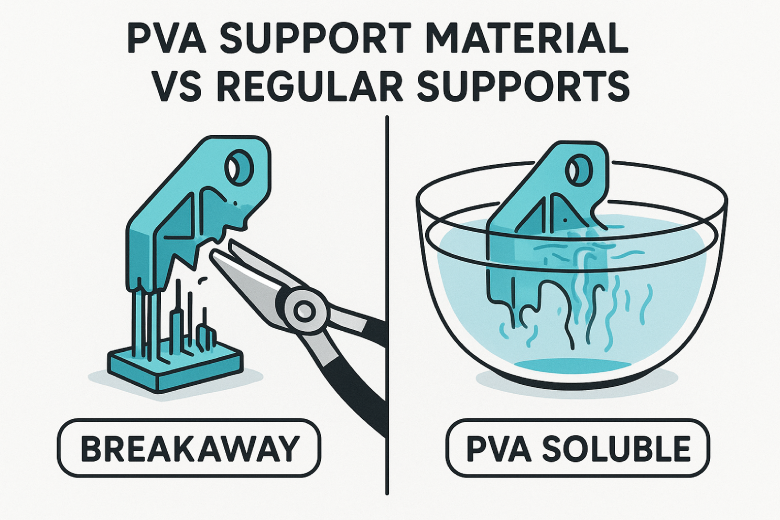
Two common options in FDM printing are regular (breakaway) supports and PVA supports. Both are types of soluble supports only when the support material can be removed by dissolving—PVA is the most common example.
Quick decision: PVA vs regular supports
|
If you care most about… |
Pick this |
Why |
|---|---|---|
|
Low cost and simple workflow |
Regular (breakaway) supports |
One filament, one nozzle, fast cleanup |
|
Best surface finish on supported areas |
PVA (soluble) supports |
Supports dissolve instead of tearing off and scarring |
|
Internal cavities or trapped supports |
PVA supports |
Water can reach places pliers can’t |
|
Fragile details you don’t want to stress |
PVA supports |
Less prying and bending during removal |
|
Maximum reliability with fewer variables |
Regular supports |
PVA is moisture-sensitive and can be finicky |
Key Takeaway: Start with regular supports. Save PVA support material for prints where support removal would be painful—or impossible.
Regular breakaway supports: the beginner default
Regular supports are what most slicers generate by default: scaffolding printed from the same material as your model.
- Printing PLA? Your supports are PLA.
- Printing PETG? Your supports are PETG.
You remove them mechanically—by snapping, cutting, and peeling.
A lot of beginners get better results just by learning a few slicer knobs (support density, overhang angle, and the support interface layer). If you want a step-by-step walkthrough, start with Sovol’s guide: How to Add 3D Printing Supports for Beginners.
The downside
Breakaway supports can fuse too strongly, leaving:
- rough “support scars”
- lost detail on small features
- extra sanding time
PVA support material: what it is and when it’s worth it
PVA (polyvinyl alcohol) is a filament that dissolves in water. Instead of snapping supports off, you soak the print and let the PVA break down and wash away.
As Simplify3D explains in its PVA materials guide, this is especially useful for complex shapes and enclosed areas where normal supports are hard to remove cleanly.
What you need (and what makes it tricky)
To print PVA supports in the same job as your model, you typically need a dual-extrusion or multi-material setup.
You also need a workflow to keep PVA dry. Prusa’s water-soluble PVA/BVOH notes (2025) emphasize that these filaments are very hygroscopic (they soak up moisture from the air), which can cause poor print quality and extrusion problems.
The trade-offs that matter
Surface finish
PVA often wins when you care about the underside of a supported surface—because removal doesn’t involve ripping plastic away with tools. That’s the big appeal of soluble supports in general.
If you don’t have PVA (or don’t want the extra workflow), you can still reduce marks by tuning support contact settings and post-processing. Sovol shares practical options in How to achieve better aesthetic results in FDM 3D printing.
Complexity and time
PVA can save you from difficult cleanup, but it adds:
- more material management (drying, storage)
- extra purge waste when swapping materials
- soak time for removal
According to Bambu Lab’s PVA printing guide, dissolving can take hours, and warm water plus agitation can speed it up. (Be cautious with very hot water on PLA parts to reduce the risk of softening.)
If you try PVA supports, do these 5 things
- Keep the spool dry. Use a drybox or sealed container with desiccant (Prusa 2025).
- Use PVA only where it counts. Many setups let you print just a soluble interface to reduce cost and purge time.
- Avoid overheating and long idle time. PVA is more prone to clogging if it sits hot without extrusion.
- Use stable supports. Very tall, thin supports can be less reliable than more stable patterns.
- Plan your soak. For easier removal, break off big chunks first, then dissolve the rest.
How to dissolve PVA supports (the safe beginner version)
If you’re searching for how to dissolve PVA supports, here’s the simple approach:
- Use a container of warm water (not boiling).
- Swish or stir occasionally to speed things up.
- Rinse the print afterward and let it dry fully.
The exact dissolve time depends on how much PVA you used, water temperature, and agitation (Bambu Lab).
When you should skip PVA
Regular supports are usually the better choice when:
- the supported area won’t be visible
- the supports are easy to grab with pliers
- you’re printing fast prototypes
- you don’t want to babysit moisture control
If your slicer adds supports everywhere, your first win is often reducing the need for supports in the first place (orientation, cooling, and bridge tuning). Sovol’s guide to fixing bridging problems is a good next step.
Next steps
If you’re building out a hobby setup, it helps to use a printer ecosystem with lots of community profiles and shared tuning knowledge. Brands like Sovol lean into open-source and community-driven learning—useful when you’re figuring out supports, materials, and slicer settings.
