


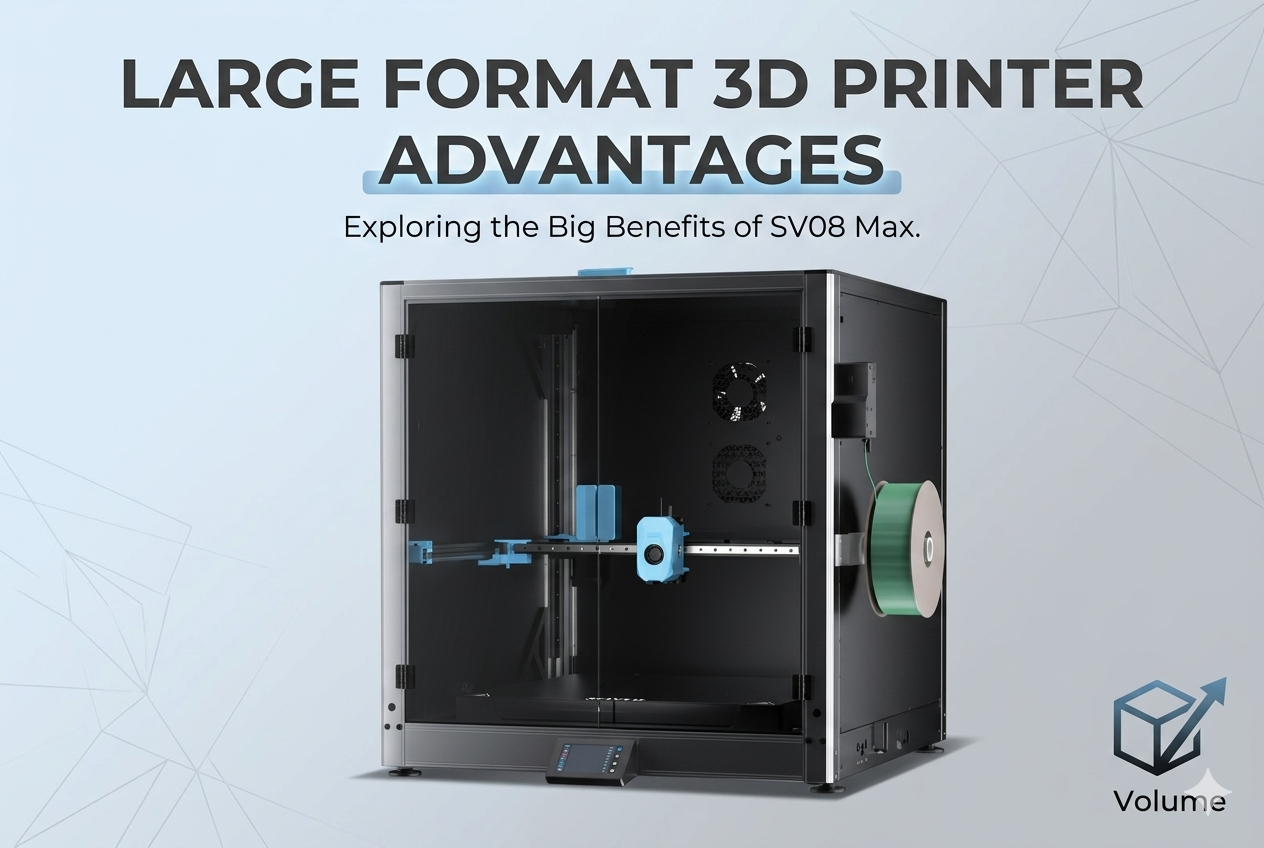
If you’re a product designer, a “large format” printer isn’t about bragging rights. It’s about whether you can validate a design in the real world without turning your prototype into a jigsaw puzzle.
A large format 3D printer can remove seams, reduce assembly, and let you test full-scale ergonomics sooner. It can also burn a weekend (and a spool) when a 20-hour print warps at hour 17.
This guide is built for the consideration stage: how to decide if a large build volume 3D printer is actually the right tool for your prototyping workflow, and what to look for if you’re evaluating a 500×500×500 class machine.
What counts as a “large format” 3D printer?
In desktop FDM terms, “large format” usually means a build volume that breaks past the standard 220–300 mm class on at least one axis. A practical threshold is 300 mm+ on one axis, with “big volume 3D printer” setups often landing in the 350–500 mm range.
A 500x500x500 3D printer sits in a different category because it changes what’s feasible to print in one piece: large housings, fixtures, big ducting, full-size mockups, and multi-part test batches.
Key takeaway: Large-scale 3D printing doesn’t just scale your parts. It scales your risk. The right features are the ones that reduce “multi-hour print failure probability,” not just the ones that push a higher headline speed.
Large format 3D printer pros and cons (quick comparison)
|
Dimension |
What you gain at 500 mm-class |
What you trade away |
|---|---|---|
|
One-piece prototypes |
Fewer seams, fewer fasteners, fewer tolerance stack-ups |
Longer prints mean more chances to fail late |
|
Validation quality |
Full-scale fit/assembly checks, more realistic handling |
More warping risk on big flat footprints |
|
Throughput options |
Batch multiple variants or fixtures in one job |
A single failure can waste more time/material |
|
Materials |
More room for enclosures, thermal stability, higher-temp workflows |
Space, ventilation, and noise become real constraints |
|
Process maturity |
Better motion systems and leveling can make big prints repeatable |
Setup, calibration, and maintenance matter more |
The real advantages of a large build volume 3D printer for prototyping
1) You stop “designing around seams”
On a small printer, you often split parts because you have to. On a large format 3D printer, you split parts because you want to.
That shift matters because split lines usually create one of these problems:
- Weak points (bond lines, fastener bosses, thin overlaps)
- Geometry compromises (features you move or simplify just so they fit)
- Time tax (post-processing, bonding, sanding, drilling, rework)
For engineering prototypes, “one piece” isn’t aesthetic. It’s functional: fewer joints means fewer unknowns in fit checks and fewer failure points in load handling.
2) Full-scale ergonomics and envelope checks happen earlier
If you’re validating a handle, a control layout, a housing that has to clear a cable harness, or a part that mates across multiple subassemblies, scale matters.
A large build volume 3D printer lets you do:
- 1:1 physical checks before you commit to expensive prototype tooling
- assembly choreography testing (can it actually be installed with real hands/tools?)
- clearance validation using real fasteners and real routing paths
This is where large-scale 3D printing often pays for itself: it catches the “annoying, expensive surprises” early.
3) Batch printing becomes a legitimate iteration strategy
The obvious use case is “print one huge thing.” The more practical use case for product teams is often:
- Print multiple smaller parts, fixtures, or variants in one job
- Fill the plate with A/B test geometry (different ribs, latch designs, wall thicknesses)
If you have the reliability to run long jobs, a big volume 3D printer can turn iteration into a single overnight cycle.
4) More stable motion systems can matter more at scale
Large beds and long gantry spans amplify vibration and resonance. That’s why motion design (and how it’s tuned) becomes an advantage, not a spec-sheet footnote.
CoreXY architectures and rigidity features are often chosen for large-format machines because they can handle higher acceleration with fewer artifacts if the system is stiff and well tuned.
The tradeoffs product teams underestimate
1) Warping isn’t a “small problem” on large parts
Warping happens because plastic shrinks as it cools, and large prints create bigger thermal gradients. The bigger the footprint, the more edge lift and internal stress you’re asking the machine to manage.
If you print ABS, nylon, or anything warp-prone, you’ll care about:
- enclosure or controlled environment
- bed heating uniformity
- first-layer consistency across the full plate
If you need a practical overview of causes and fixes, see Wevolver’s 3D print warping fixes.
2) Long prints change how you think about failure
A 2-hour prototype can fail and you shrug.
A 20-hour prototype fails and you’ve lost:
- time
- material
- schedule credibility with your team
That’s why “reliability features” are not marketing fluff on a large format 3D printer. They’re risk controls: runout detection, jam detection, monitoring, and power-loss resume.
For a broad list of common print failure modes (adhesion issues, layer shifts, under-extrusion), All3DP’s troubleshooting guide is a useful reference.
3) Space, airflow, and noise become part of the spec
A 500 mm-class machine isn’t a casual desktop appliance.
Plan for:
- a stable bench or stand that won’t wobble
- room to access the printer from multiple sides
- ventilation if you print higher-temp materials
If your environment can’t support that, the “advantage” becomes friction.
How to evaluate a large format 3D printer (what matters most)
This is the part most buyer guides get wrong: they list features. You need to map features to failure modes.
1) First-layer repeatability: leveling method and bed behavior
On a large build plate, tiny deviations become big problems. You’re optimizing for repeatability, not “it worked once.”
Look for:
- fast, consistent bed calibration
- mesh leveling behavior that holds across the full plate
- a bed that heats evenly enough to avoid edge problems
2) Thermal control: enclosure options and material reality
If you only print PLA, a full enclosure is nice-to-have.
If you print ABS, ASA, nylon, or composites, thermal control becomes a must-have. A stable environment reduces warping and layer splitting.
3) Motion system and rigidity: what happens at speed
On large machines, speed without control is just a faster way to fail.
Evaluate:
- rigidity (frame, rails, belt paths)
- how the machine handles resonance and ringing
- whether the firmware and sensors support tuning (for example, vibration sensing for compensation)
4) Filament path and “don’t ruin my weekend” sensors
Large prints fail for small reasons:
- filament tangles
- partial clogs
- moisture
- spool drag
A big volume 3D printer should make these failures less likely, or at least easier to recover from.
5) Monitoring and recovery
Remote monitoring and power-loss resume don’t make a printer “better.” They make long jobs survivable.
A concrete example: how the SV08 Max maps to the criteria
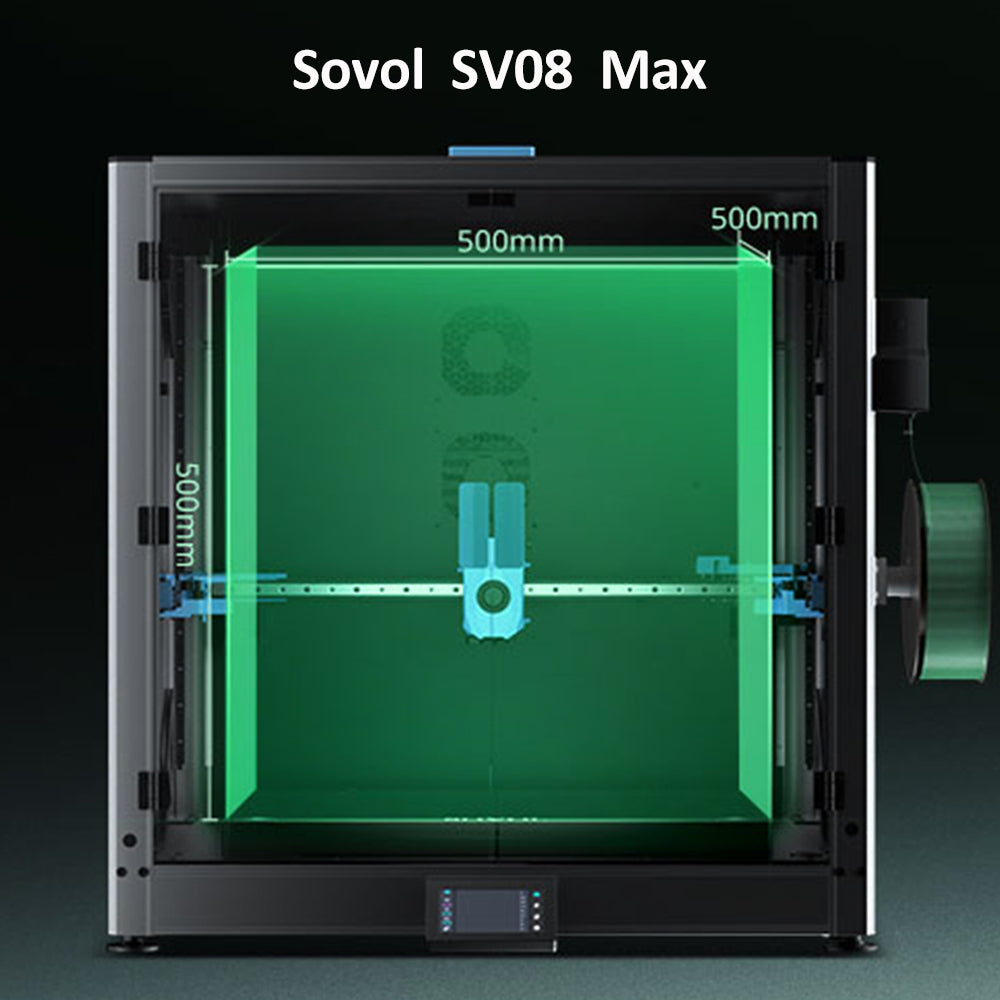
To make the evaluation less abstract, here’s how a 500x500x500 3D printer can stack up against the criteria using the Sovol SV08 Max as a reference point.
Build volume and throughput
SV08 Max is a 500 × 500 × 500 mm³ class machine. That’s large enough to:
- keep many prototypes one-piece
- batch multiple parts or fixtures for a test cycle
Motion and control
SV08 Max uses CoreXY kinematics with Klipper control and includes full linear rails (per the product specs). The important practical point isn’t the label. It’s whether the motion system stays predictable when a large part forces long travel moves.
Bed leveling and first layer
The SV08 Max product page lists an eddy current scanning leveling system for contactless bed calibration. On large-format builds, that kind of automation is valuable when it improves first-layer repeatability across the full plate.
Temperatures and material headroom
The listed specs include nozzle temperature up to 300°C and bed temperature up to 100°C, with an optional heated chamber module (sold separately). That matters if your prototyping roadmap includes tougher materials than PLA.
Reliability features for long jobs
The product page also calls out:
- filament runout detection
- power-loss resume
- a Smart Auxiliary Feeder System for tangle/clog detection
- an included ADXL sensor
- a built-in 1280×720 camera
Again, the decision lens is simple: do these features reduce the probability and cost of a late-stage failure?
When a large format 3D printer is worth it (and when it’s not)
Worth it when:
- you routinely prototype parts that force splits on 250–350 mm machines
- seams are compromising your test (strength, fit, sealing, aesthetics)
- you benefit from batching variants (fixtures, housings, ribs/latches) into one overnight run
- your team can support calibration and preventive maintenance
Usually not worth it when:
- your parts fit comfortably in the 300–350 mm class and you rarely split
- you mostly print quick concept models where surface finish matters more than strength
- you don’t have the space or ventilation for a large machine
- you can’t tolerate long-print risk in your current workflow
If you’re on the fence, don’t force it into a yes/no decision. Define one “killer prototype” your current setup can’t do cleanly. If a large build volume 3D printer would remove two or more steps (splitting + bonding + sanding + reinforcement), the ROI is usually real.
Next steps
If you’re specifically evaluating the SV08 Max class of machine, use your next prototype as a test case:
- pick a part you currently split
- estimate the real cost of splitting (labor + rework + accuracy loss)
- then compare it to a one-piece print plan (with enclosure/thermal considerations)
- For a deeper SV08 Max-specific read, see SV08 Max review: is 500×500×500 mm worth it?.
Further context on prototyping processes: If you’re comparing FDM to other prototyping options, Formlabs’ guide to choosing FDM vs SLA vs SLS is a solid starting point, and SyBridge on FDM advantages and disadvantages adds a manufacturing-oriented view of tradeoffs.
