


Introduction
Short answer: A 3D print can last for years or decades as a decorative indoor object, while functional parts may need replacement much sooner. There is no reliable lifespan number for every print: material, load, temperature, sunlight, moisture, print orientation and design all affect how long it remains safe and useful.
A useful starting point is to judge the part by its job: decorative, everyday-use or load-bearing. The sections below explain the failure mechanisms behind those differences and how to make a print last longer.
A printed shelf ornament and a printed hook holding a wet towel are both "3D printed objects," but they do not age on the same clock. The ornament mostly has to survive dust and a sunny windowsill. The hook has to survive a steady pull, warmth, and possibly years of it. Ask how long a print lasts and the honest answer is that there is no single number, because a print does not wear out like a shoe. It fails in a specific way, and its lifetime is how long that failure takes to reach the point where the part stops doing its job.
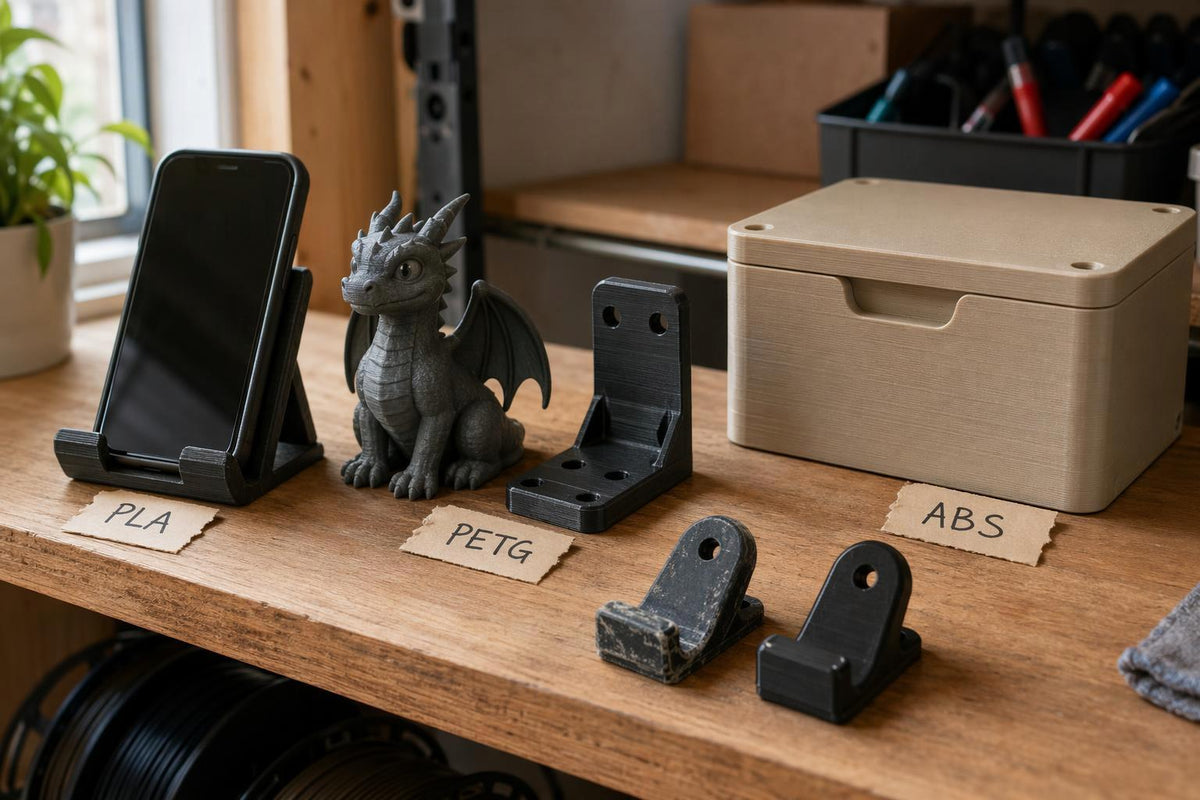
This guide sorts printed objects into three rough tiers: decorative, everyday-use, and load-bearing. It then walks through the four things that decide which tier a part really belongs to: the material, the load it carries, the environment it lives in, and how it was printed. The ranges below are conditioned estimates drawn from material data sheets, published mechanical studies, and practical experience. They are starting points for your own judgment, not a warranty.
Key takeaways
- Decorative indoor prints can sit on a shelf for years to decades, provided they stay out of direct sun and away from heat sources.
- Everyday items such as clips, cable guides, and phone stands live or die on creep and fatigue, not on gradual surface wear.
- Layer orientation often matters more than filament choice: a part loaded across its layer bonds can fail at a fraction of the material's in-plane strength.
- The cheapest reliability upgrade is usually geometry and orientation, not a more expensive filament.
- For outdoor parts, a UV-resistant coating is generally a better return on effort than annealing.
Why "how long" has no single answer
A printed part has a failure mode, and the useful question is which one applies and how fast it is progressing. Four mechanisms cover most real-world failures.
Creep is slow deformation under a steady load. A thermoplastic held below its yield point can still flow over time, and the rate climbs sharply as the part approaches its glass transition temperature (Tg). This is why the same PLA hook sags on a warm windowsill and holds in a cool hallway.
Fatigue is cracking under repeated flex. Each cycle concentrates stress at the thinnest feature, and in FDM parts the crack usually runs along a layer bond rather than through the bulk plastic.
Photo-oxidation is chemical breakdown from sunlight. UV radiation breaks polymer chains, and the rate depends heavily on the material, its stabilizers, and its color.
Moisture is the quiet one. Some filaments absorb water that plasticizes the polymer or drives hydrolysis, and the effect can be slow enough to go unnoticed until a part turns brittle.
You do not need lab equipment to use this vocabulary. When a part fails, ask which of the four was at work. A sagging hook is creep. A clip that snaps after a few dozen uses is fatigue. A garden bracket that crumbles after two summers is UV and moisture. The diagnosis tells you what to change.
The three tiers: decorative, everyday, load-bearing
|
Tier |
Typical parts |
Dominant failure mode |
Realistic range |
|---|---|---|---|
|
Decorative |
Figures, lithophanes, desk ornaments, display models |
UV and heat discoloration or warping; dust and handling |
Years to decades indoors, out of sun and heat |
|
Everyday use |
Cable clips, utensil holders, phone stands, drawer dividers |
Creep under light steady load; fatigue at flex points |
Months to a few years, depending on load and cycles |
|
Load-bearing |
Hooks, brackets, clamps, wall mounts |
Creep and fatigue at layer bonds and stress concentrations |
Weeks to years, highly variable |
These ranges are conditioned estimates, not measured field lifetimes. A well-designed PETG hook printed in the right orientation can outlast a badly oriented PLA one by a wide margin, which is why the tier is a starting point rather than a verdict. The decorative row assumes the part is kept away from a radiator, a car dashboard, and direct sun through glass. The load-bearing row is short and wide because a hook holding a 200 g key ring and a bracket holding a 5 kg shelf are not the same problem.
What actually kills a print: creep, fatigue, and UV
Creep. A steady load below the yield point still causes slow deformation, and it accelerates as the part approaches its glass transition temperature. PLA's Tg sits around 55–60 °C, PETG's around 80–85 °C, and ABS's around 100–110 °C, per All3DP's summary of the three materials. A dark PLA part in direct summer sun can approach its Tg while carrying load, which is why PLA is the wrong choice for anything warm or continuously loaded. What to change: move the part out of heat, switch to a higher-Tg material, or add design margin so the load is a smaller fraction of the part's strength.
Fatigue. Repeated flexing concentrates stress at a thin feature, and the part cracks at the layer bond rather than in the bulk material. The fix is geometric: spread the strain over a longer, thinner beam instead of a short, thick one, and fillet the root where the flex concentrates. Material choice matters too. Ductile filaments tolerate cycling far better than brittle ones.
UV. Sunlight breaks polymer chains, and the rate depends heavily on material and color. Opsytec's UV-aging overview rates ASA as the best of the common filaments for permanent UV exposure and calls PLA and standard PETG unsuitable for it. One finding there runs against intuition: under controlled UV-C irradiation, PETG lost considerably more tensile strength than PLA, which shows that "good in sunlight" and "good under a specific UV band" are not the same claim. What to change: use ASA or a UV-stabilized grade outdoors, choose dark opaque colors where you can, and add a coating if the part must face years of sun.
Moisture. Nylon is the classic case. Absorbed water plasticizes the polymer and changes its mechanical behavior, so nylon parts need dry filament and, outdoors, a stabilized grade. What to change: dry the filament before printing, store it dry, and do not expect an unstabilized nylon part to shrug off a damp garden.
Material by material: honest limits
PLA. Stiff, easy to print, and dimensionally forgiving, but brittle and heat-sensitive. It is fine for decorative pieces and light indoor use. It is a poor choice for snap-fits and anything that lives in a warm car. Note that the glass transition figures above describe the polymer, not a guarantee for a printed part; heat deflection under load is the more useful number for a finished object.
PETG. Ductile, moisture-tolerant, and a solid default for everyday items. Its data sheet shows why "the material" is not one number: Polymaker's PolyLite PETG sheet lists tensile strength of 50.8 MPa in the X-Y plane against 42.8 MPa in Z, with elongation at break dropping from 8.4% to 3.3%. PETG still creeps under sustained load, and it yellows outdoors.
ASA. The outdoor choice among styrenics. Polymaker's ASA sheet gives a Tg of 98 °C and tensile strength of 43.8 MPa in X-Y versus 32 MPa in Z, with elongation at break falling from 6.7% to 1.65%. ASA is UV-stable where ABS is not, but it wants an enclosure and still warps.
ABS. Tough and cheap, but UV-weak and warp-prone. It belongs in shaded indoor applications, not on a balcony.
TPU. Flex and impact resistance, not structural stiffness. Useful for feet, grips, and bumpers, not for a bracket that has to hold a shelf.
Nylon. Excellent fatigue and snap-fit behavior, which makes it the material for living hinges and repeated snaps. It is moisture-sensitive, so it needs drying and, outdoors, a stabilized grade.
PC. Strong and heat-resistant, but UV-permeable unless stabilized. 3DJake's outdoor filament guide notes that untreated PC yellows within months in intense sun, while stabilized grades last considerably longer. For permanent outdoor use, specify the stabilized version.
One caveat applies to every row: data-sheet values are typical properties for a standardized specimen, and manufacturers explicitly warn they are not design specifications. Your print settings, color, and part geometry will shift the result.
Layer orientation: the decision that outranks filament choice
FDM parts are weakest across their layer bonds, and the numbers are not subtle. NatureWorks' Ingeo 3D870 data sheet lists tensile strength of 40 MPa in the XY axis, 32 MPa in YX, and 24 MPa in ZX. A study of PLA interlayer interfaces measured printed specimens at 22.8 MPa against the bulk filament, a 47.8% reduction in strength and a 32.4% reduction in stiffness. The failure was brittle and ran along a single layer plane.
That translates directly into orientation rules for real objects:
- Hooks. Print so the load pulls along the layers, not across them. A hook printed standing up puts the hanging load on its weakest plane.
- Handles and brackets. Keep the bending axis in-plane. If the part will bend, the bend should run along continuous extrusions.
- Snap-fits and living hinges. These must flex along continuous extrusions, never across layer bonds. DFAM Academy's snap-fit guide puts it bluntly: a snap printed so it flexes across layers snaps on the first click. It also rates PLA as poor for repeated snaps; PETG and ABS/ASA as good; and nylon and PP as excellent, calling nylon best for repeated cycling and PP the living-hinge material.
A simple test: look at the part and ask which way it will bend or pull. Then rotate the model so that direction runs along the print plane. This one decision often buys more life than switching filaments.
Design details that buy years
Geometry fixes cost nothing but attention, and they are where a part earns its extra years.
Fillet the stress concentrations. A sharp inside corner is where a crack starts. A generous fillet at the root of a hook or the base of a snap beam spreads the load over more material.
Taper flexing beams. A cantilever snap should be thicker at the root and thinner at the tip so strain spreads along its length instead of spiking at the base. Length beats thickness for deflection: a longer beam flexes further at lower strain than a short stubby one.
Put material where the load is. Wall count and infill distribution matter more than a single infill percentage. A hook needs solid material in the shank and the throat, not uniform density everywhere.
Design clearance into assemblies. Snap features need engagement clearance so they seat without forcing. DFAM Academy suggests roughly 0.2–0.4 mm on FDM, validated on a printed coupon in the real orientation before committing the part.
Keep living hinges thin and flat. A living hinge works at roughly 0.3–0.5 mm thickness, printed flat so it bends in-plane, and it belongs in PP or nylon rather than PLA. Hubs' living hinge guide adds that a well-designed hinge has a longer curved outer surface to accommodate tensile stress when it opens and closes.
Is annealing or a coating worth it?
Annealing. Heat treatment can raise tensile strength modestly and improve heat resistance, but the evidence is mixed and it does not fix layer adhesion. CNC Kitchen's controlled test found about 7.5% more tensile strength and 16% on lying hooks, while layer adhesion stayed at 42 kg before and after. Heat treating will not fuse layers. It also costs dimensional accuracy through warping and shrinkage, so it suits simple parts like hooks and handles, not precision fits. Prusa's annealing tests found PLA warping badly above 70 °C and ABS/ASA warping more than the others, while PETG held shape reasonably at 110 °C. If you anneal, expect to compensate dimensions and test on scrap first.
Coatings. A UV-resistant clear coat or paint is a cheap, effective way to extend outdoor life, especially for PETG and PLA. It seals the surface and blocks some of the radiation that drives photo-oxidation. For outdoor parts, a coating is usually a better return than annealing: it addresses the failure mode that actually dominates outside, and it does not disturb the part's dimensions.
The trade-off is plain. Anneal when you need heat resistance or a little more strength in a simple shape and can tolerate movement. Coat when the part faces sun and you want to keep its fit.
A decision framework: match the lifetime you need to the effort you spend
Ask three questions before choosing a filament or a print orientation.
- How long must it last? A weekend prop and a permanent wall hook justify different effort.
- What will it be exposed to? Load, heat, sun, and moisture are the four exposures that matter.
- How much is a failure worth? A cracked desk toy is an annoyance. A failed hook drops what it was holding.
Map the answers to a starting point:
- Decorative indoor: PLA, any orientation, no post-processing.
- Everyday indoor: PETG, orientation-aware, fillets at stress points.
- Warm or loaded: PETG or ASA with design margin; consider annealing only for simple shapes.
- Outdoor: ASA or UV-stabilized PC or nylon, plus a coating.
- Repeated flex: nylon or PP, printed flat so the flex runs along the layers.
This is a value judgment, not a measured rule. Over-building a desk toy wastes time; under-building a load-bearing hook wastes the thing it was holding. The tiers and ranges in this guide are starting points to adjust for your own load and environment.
Related resources
- Polymaker PolyLite PETG technical data sheet: X-Y versus Z tensile and elongation values for a common PETG.
- Polymaker ASA technical data sheet: thermal and mechanical properties for the outdoor styrenic option.
- NatureWorks Ingeo 3D870 data sheet: directional tensile data for a PLA grade formulated for 3D printing.
- Perez et al., interlayer interface strength in FDM PLA: how much strength the layer bonds cost.
- Amza et al., accelerated UV-B aging of PLA and PETG: tensile, compressive, and creep changes after UV exposure.
- Opsytec UV-aging overview for 3D printing materials: material-by-material weathering comparison.
- DFAM Academy snap-fit and living hinge guide: orientation, taper, fillet, and material rules for flexing features.
- Hubs living hinge design guide: hinge geometry and material recommendations.
- CNC Kitchen annealing test: what annealing does and does not change.
Still have questions?
The ranges in this guide are starting points, not predictions for your specific part. If something you printed failed early, the most useful thing you can do is note how it failed: did it sag, snap along a layer line, crack at a corner, or turn brittle after a summer outside? That detail points to the mechanism, and the mechanism points to the fix. Share what happened and how the part was printed, and you will get a more specific answer than any general table can give.



Laisser un commentaire
Ce site est protégé par hCaptcha, et la Politique de confidentialité et les Conditions de service de hCaptcha s’appliquent.